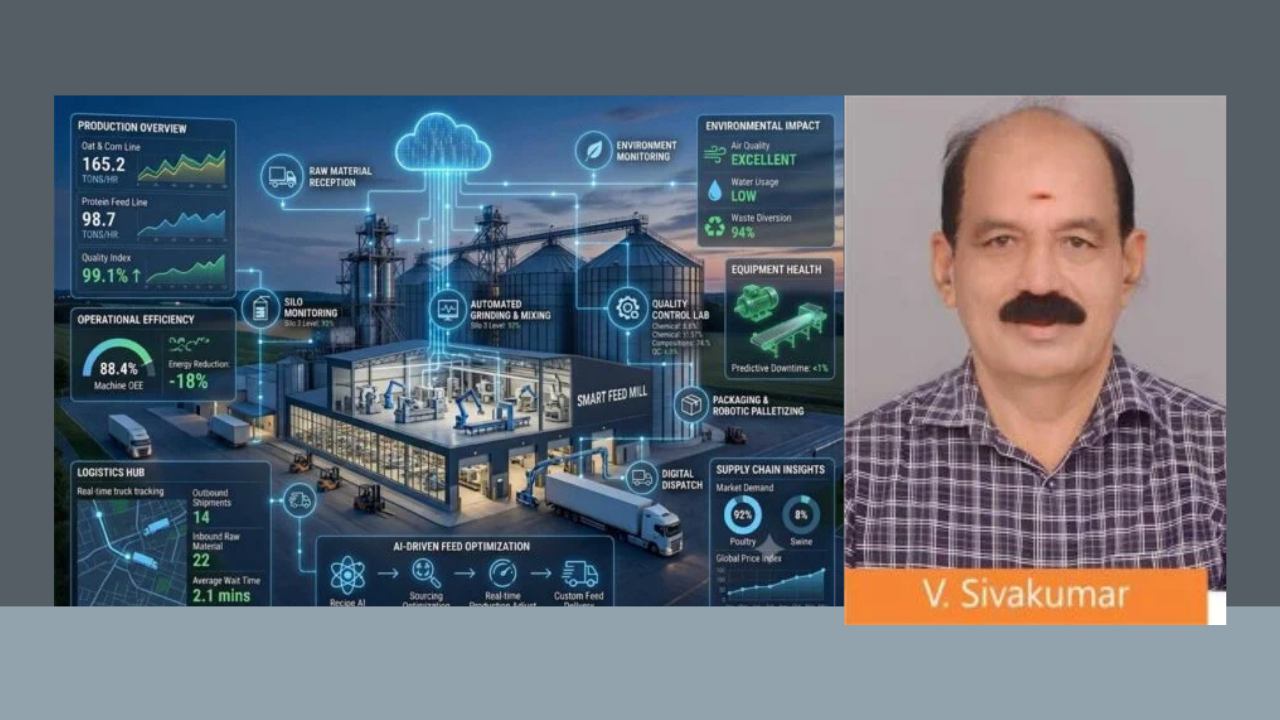
Part 1: The Smart Storage Hub
Bridging Advanced Automation and Autonomous AI in Feed Manufacturing
Introduction
The Indian animal feed industry operates under one of the world’s most demanding combinations of climate volatility, raw-material variability, and supply-chain pressure.
Unlike highly standardized Western milling systems, an Indian feed mill cannot assume that grain entering the plant will be uniform. On any given day, intake hoppers may receive dense, low-moisture winter maize from Bihar alongside unstable, high-moisture monsoon grain from Madhya Pradesh or Karnataka, with each lot differing in kernel size, density, and moisture profile.
Once this heterogeneous material stream enters bulk silos, a second challenge emerges: tropical thermodynamics. Intense daytime solar loading followed by sharp night-time cooling drives moisture migration inside the stored grain mass. These internal convection loops trap water vapour beneath the silo roof, creating microclimates that accelerate crust formation, mold growth, and mycotoxin risk.
“Protecting grain biology is no longer enough. A modern feed mill must also protect traceability, inventory accuracy, and profit.”
For more than two decades, the industry’s standard response has been mechanization through programmable logic controllers (PLCs) and SCADA dashboards. However, conventional automation remains largely reactive. It depends on static, rule-based thresholds that raise alarms only after a critical hot spot has already compromised grain condition. It also fails to identify hidden financial losses developing within the bin, because it cannot distinguish natural thermodynamic moisture shrinkage during aeration from physical process loss caused by conveyors, friction, and dust aspiration.
The implication is clear: a modern feed mill must move beyond basic digital control toward autonomous intelligence built on a fundamentally different factory data architecture.
- Structural Material Science: Defeating the Tropical Convection Loop
Before deploying advanced software algorithms, the physical repository must be engineered to withstand severe tropical stress. In Indian coastal and high-humidity interior zones, standard Z275 galvanized steel sheets degrade rapidly at bolted seams and joints where condensation pathways develop. Long-term structural integrity requires Z600 galvanization or, preferably, ZM310 (Magnelis) coatings, a zinc-aluminum-magnesium alloy which provide superior corrosion resistance.
The structural engineering must actively combat moisture migration. Solar heating and night-time cooling create convection currents inside the silo. Moist air rises, condenses beneath the roof, and falls back onto the grain surface, creating moisture pockets that encourage mould-prone crust.
Defeating this loop requires a high-performance ventilation layout. The system must move away from passive gravity vents to motorized roof exhausters linked to ambient humidity sensors, combined with heavy-duty aeration fans. Air must be distributed uniformly through a fully perforated flush steel floor, preventing dead zones caused by the fine dust and dockage variations typical of multi-state grain shipments.
- Operational Asset vs. Long-Term Vault
A critical engineering mistake in plant layouts is treating all silos as functionally identical. An intelligent mill explicitly separates the design parameters between two distinct assets:
Continuous Flow Silos: The Processing Engine
These silos act as buffer bins between grain intake and the grinding line. Grain retention time is typically only 12 to 72 hours. Because these bins are filled and emptied multiple times a week, the dominant risk is mechanical abrasive wear on the walls. The digital twin focus here is high-speed volumetric level tracking and gate positioning to keep the downstream hammer mill line balanced.
Seasonal Storage Silos: The Long-Term Vault
These silos hold grain for 3 to 9 months to hedge against seasonal price shifts. Because the grain mass remains largely static, thermodynamic convection loops become the dominant risk. The digital twin focus shifts entirely to thermodynamic trend profiling and micro-climate control.
“A system designed to protect fast-moving operational assets cannot use the same data cadence or control priorities as one designed to safeguard long-duration inventory value.”
- The Architecture of the Decoupled Digital Twin
Dumping operations, maintenance data, and accounting records onto a single SCADA screen causes data fatigue and system latency. True Industry 4.0 demands a decoupled cyber-physical system where tasks are split across two specialized, communicating virtual platforms connected via secure API layers.
Twin A: The Physical Execution Twin
This twin operates in milliseconds and interfaces directly with high-density multi-node digital thermocouple cables, headspace carbon dioxide sensors, and 3D acoustic surface scanners.
Its intelligence includes continuous calculation of Equilibrium Moisture Content (EMC), automatic lockout of aeration fans when outdoor relative humidity is too high, and early detection of organic respiration through headspace CO₂ spikes before thermal cables register a measurable temperature increase.
Twin B: The Analytical Twin
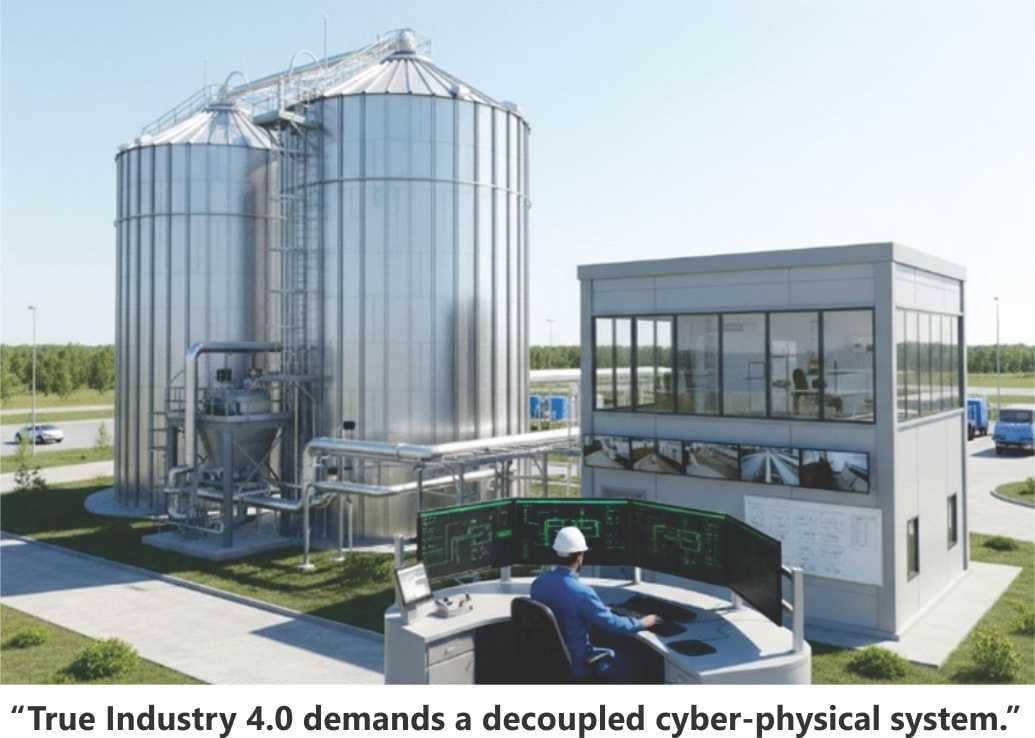 This twin operates on an hourly or daily cadence and links the physical silo to the mill’s ERP and weighbridge records. It tracks the grain’s commercial profile from origin to processing, creating a data-driven birth certificate for every batch.
This separation is more than a software design choice. It is the foundation for financial clarity. Once the Physical Execution Twin controls the storage environment and the Analytical Twin records mass movement, the mill can begin distinguishing biological stability from commercial loss with precision.
- The Math of Profit Protection: Moisture Shrinkage vs. Process Loss
To bridge the gap between factory physics and financial accounting, the Analytical Twin tracks and quantifies mass changes across two categories.
Thermodynamic Moisture Shrinkage
When high-moisture grain is aerated down to a stable storage baseline, weight is lost purely through water vapour evaporation. The Analytical Twin tracks this using a water-mass balance relationship between incoming moisture content and final verified moisture content.
For example, if a mill receives 2,000 tonnes of maize at 16% moisture and aerates it down to 13%, the true weight loss is 3.45%. Simply subtracting moisture percentages (16% – 13% = 3%) creates a 0.45% accounting blind spot, hiding 9 tonnes of missing grain that would otherwise disrupt inventory reconciliation.
Mechanical Process Loss
Unlike moisture evaporation, process loss represents the physical disappearance of dry matter during handling. This occurs through dust extraction systems at the dump hopper, friction damage in high-speed bucket elevators, and terminal residuals. The system therefore compares actual discharge against moisture-adjusted expected stock to isolate true mechanical loss.
24-Hour Continuous Verification
To achieve high accuracy, the Digital Twin uses 24-hour continuous inline Near-Infrared (NIR) moisture sensors mounted at both the intake drag conveyor and the reclaiming discharge chute. By continuously sampling the moisture profile of the moving material stream, the system isolates exactly how much weight loss was natural water evaporation versus physical mechanical leakage.
“In a 500-ton-per-day feed mill, an untracked 0.5% variance can leak more than 75 tonnes of raw-material value annually.”
- Quantifying the Three Phases of Emptying
A final inventory blind spot occurs during the silo discharge sequence. The Analytical Twin monitors and quantifies this process across three distinct physical phases:
Gravity Flow
This phase accounts for approximately 80% to 85% of total mass through central funnel flow. It is monitored via linear proximity sensors on the rack-and-pinion gates and quantified using inline solids impact flow meters that integrate deflection force over time.
Sweep Auger Operation
This phase clears the leftover peripheral grain cone, typically 10% to 14% of total mass. Because inline weight sensors cannot be placed inside a rotating arm, the system uses a motor amperage integration proxy.
Manual Seepage
This final floor cleanup accounts for less than 1% of total mass. The digital twin tracks this using top-mounted 3D acoustic surface differential mapping or by routing the cleanout batch to an isolated scale downstream to close the mass balance loop completely.
By quantifying each discharge phase separately, the Digital Twin converts what was once treated as residual handling noise into traceable operational data. That closes the analytical chain from grain intake to final cleanout and sets up a dashboard that leadership can use for both daily control and strategic decision-making.
Why the Smart Storage Hub Matters
The Smart Storage Hub is more than a storage concept. It is a practical framework for protecting grain quality, improving inventory accuracy, and reducing hidden losses in Indian feed mills. By separating the physical execution layer from the analytical business layer, the mill can monitor temperature, moisture, gas activity, and mass movement in real time while also reconciling commercial stock with greater precision.
- Detect hot spots before crusting begins
- Distinguish moisture shrinkage from process loss
- Improve traceability from intake to discharge
- Support better procurement decisions with origin-based performance data
Conclusion
A decoupled digital twin converts storage data into actionable intelligence, enabling better grain preservation, inventory control, and commercial decision-making.
“By decoupling physical silo operations from inventory logistics analytics, a cyber-physical Digital Twin transforms storage from a historical black box into a precise, transparent, and self-optimizing profit center.”
About the author
Sivakumar is the founder of Feed Tech Engineering, Coimbatore, and a freelance silo, feed milling & automation consultant and writes on feed mill systems, grain storage engineering, and digital process intelligence in the Indian feed industry.
By V. Sivakumar, Founder, Feed Tech Engineering, Coimbatore