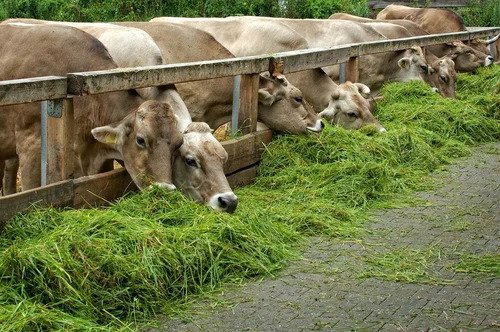
Uttar Pradesh is facing a significant shortage of green fodder, with a deficit estimated at around 45%, posing a challenge to livestock productivity and the rural dairy economy. Despite having a total agricultural area of about 166.84 lakh hectares, only 2.41 lakh hectares—less than 1.5%—is currently under green fodder cultivation. Within this limited area, crop distribution remains highly skewed, with sugarcane occupying nearly 80% of the fodder acreage.
According to officials, the imbalance has led to a substantial gap in green fodder availability, even as dry fodder remains marginally surplus at around 3%. This shortage has direct implications for milk production, animal health, and the overall cost of livestock management, particularly for small and rural farmers.
To address the issue, the state government has initiated a multi-departmental strategy under a task force led by Chief Secretary S. P. Goyal. The initiative involves coordination across agriculture, horticulture, animal husbandry, and other departments, along with expert consultations to develop sustainable solutions.
One of the key focus areas is reclaiming traditional grazing and meadow lands. Of the approximately 65,000 hectares previously encroached upon, nearly 50,000 hectares have been cleared, with green fodder cultivation already initiated on around 6,000 hectares. Efforts are also underway to create localized fodder supply systems by linking over 7,000 cow shelters—housing more than 12 lakh stray cattle—with nearby fodder-producing fields.
The strategy further emphasizes a shift toward participatory models by involving Farmer Producer Organisations (FPOs), NGOs, and rural youth in fodder cultivation. The government plans to support these efforts through quality seeds, technical guidance, and extension services, enabling a more decentralized and market-driven approach.
Experts have highlighted the need for diversification of fodder crops, promotion of silage-making, and better utilization of crop residues such as wheat straw, paddy stubble, and maize stalks. While these measures are expected to improve fodder availability, sustained implementation will be critical, particularly as feed costs continue to rise and dairy margins remain under pressure.