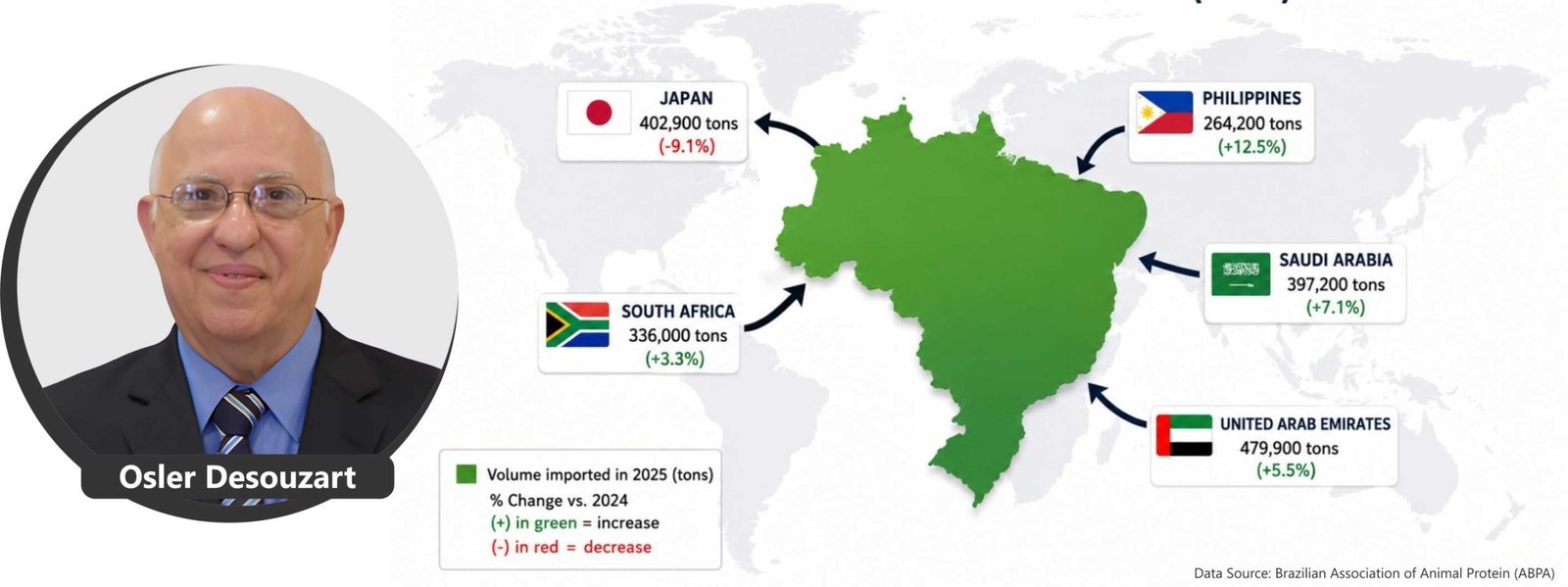
Brazil’s rise as a global poultry powerhouse goes beyond production scale and cost competitiveness. Its success has been built on collaboration, continuous improvement, market development and a strong “hunt as a pack, defend as a pack” mindset.
Osler Desouzart, founder of OD Consulting, Market Planning & Strategy, is an internationally recognised expert in agricultural trade and animal protein markets. Having contributed to Brazil’s poultry and meat export industries, he has worked with organisations across 39 countries and advises and speaks globally on market trends, competitiveness and strategic development in the agri-food sector. He is also a keynote speaker at Trouw Nutrition’s upcoming FeedTechnoVision 2026.
In this interview, Desouzart discusses the Brazilian poultry model, feed-cost management, alternative raw materials, biosecurity, technology and data—and the lessons Brazil offers to poultry industries in Asia, particularly India. Below are the excerpts.
You have been closely associated with the development of Brazil’s international meat business. Looking back over the past two to three decades, what were the defining changes that transformed Brazilian poultry into a global export powerhouse?
Brazil’s poultry exports did not surge simply because of favourable exchange rates, government policies, superior genetics, a good climate, or good luck. There is a far more interesting story. Ultimately, Brazil became the world’s number-one poultry exporter by learning to hunt as a pack, defend as a pack, and bring allies together around collective goals.
Instead of competing to capture a larger share of the domestic marketplace, the mindset shifted to looking outward and asking, “Where are the opportunities for Brazil’s poultry industry to grow the global poultry market?”
When the poultry industry works together to grow an entire market, it can tackle challenges that no single company can solve alone. That requires commitment and collaboration from stakeholders across the value chain including universities, industry associations, animal nutrition companies, animal science organizations, genetics companies, suppliers, and others. Each one brings expertise that can help the entire industry improve its practices, efficiency, and products.
This spirit of cooperation, coupled with continuous improvement, has been critical to Brazil’s export surge. Achieving success requires knowledge, systems, methods, training, and technology that extend beyond the capabilities of any individual company. In Brazil, we deliberately built relationships with our “allies in the trenches” and worked together toward a shared goal.
Adopting a global perspective also opened our eyes to new market offerings. Much of the history of Brazilian poultry exports can be summed up in the phrase, “Every new chicken cut creates a new market.” Fifty years ago, we exported one product: whole chickens. Today, Brazil’s poultry sector sells hundreds of different products, and a single chicken can be transformed into numerous cuts designed for specific markets and consumer preferences.
Feed is the largest variable cost in poultry production. How has Brazil managed raw material availability, price volatility, and supply chain disruptions while maintaining competitive feed costs and bird performance? What lessons from Brazil’s experience could be relevant to other poultry-producing countries?
When it comes to feed costs, poultry producers simply do not have the margin for big mistakes. Much of Brazil’s production success comes down to managing the factors that can be controlled. This approach can be implemented in other countries.
The controllable fundamentals are well known in the industry and include genetics, nutrition, water quality, health and biosecurity, handling, housing, temperature, airflow, air quality, lighting, and stocking density. These fundamentals must be systematically managed.
When I worked at Sadia, we adopted the Japanese method of total quality management, drawing on the principles of Deming, Ishikawa, and Falconi. We measured everything, established clear parameters, and followed the PDCA cycle — Plan, Do, Check, Act. Each time we achieved a goal, we sought to improve even more.
This approach was rolled out across the company, from the executive suite to the birdhouse. Procedures had to be clearly defined and once established, people had to be trained to follow them.
I’ll share an example of how small things can have big consequences. We always monitored water quality and consumption at the farm level. When two identical broiler houses suddenly showed significantly different water intake—35 litres per bird versus 28 litres—we discovered that a small leak had gone unrepaired. A few drops of water may seem insignificant, but when contamination affects millions of birds, the magnitude is massive.
This lesson applies directly to feed and raw-material volatility where method, systems, and training are the real “magic bullets.” We cannot control every market disruption or input price, but we can control how we measure, respond, and improve.
The use of alternative feed ingredients is gaining importance globally to manage costs, availability, and sustainability. However, greater ingredient variability can affect consistency and productivity. How has Brazil approached the use of alternative raw materials and which strategies or ingredients have demonstrated real commercial success without compromising bird performance?
Brazil’s experience with alternative feed ingredients is less about finding a single solution and more about creating flexibility in how raw materials are produced, marketed, and incorporated into diets.
Corn and soybean meal have long been the basis for poultry feeds in Brazil. They are widely availability and offer well-understood nutritional value. But Brazil has also benefited from developing alternative markets for agricultural commodities. A nimble approach to market shifts has helped growers in Brazil manage supply and price fluctuations. A good example is ethanol that was derived from Brazil’s sugar cane sector in the late 1970s. Beginning in the 1990s, when corn prices were depressed, producers increasingly supplied corn to the ethanol industry. Today, ethanol production provides an important alternative outlet for Brazilian corn and has created DDGS as a coproduct. It is used primarily in ruminant nutrition but also offers opportunities for other animal species.
This example illustrates how ingredients having multiple uses, combined with multiple sources of demand for agricultural commodities, may help support more flexible formulations. Brazil produces up to three crops a year in some regions, and crop rotation is essential under the country’s no-till production system. This production environment contributes to a dynamic supply source allowing producers to respond to changing market conditions.
For poultry producers, however, the challenge is not simply in substituting one ingredient for another. Any alternative raw material must be evaluated for its nutritional value, consistency, availability, and impact on bird performance. Formulation must manage the variations in nutritional characteristics. This challenge becomes a key discussion point for professionals at industry gatherings such as FeedTechnoVision 2026, India.
Which elements of the Brazilian poultry model can realistically be replicated in Asia, particularly in markets that depend heavily on imported feed ingredients? And how might this apply to India, which has a different position as both a major producer and supplier of key feed raw materials?
As I mentioned earlier, no production region is entirely self-sufficient. While Brazil is fortunate to grow grains commonly used in poultry feed, we have to import most of the necessary microelements and we are also highly dependent on imported fertilisers.
Getting back to the “pack mentality” of working with our allies, companies in Brazil not only hunt in a pack but defend in a pack. Various brands or companies may compete intensely in their domestic markets, but when issues create risk for the future of the industry as a whole, these companies respond together.
That principle is highly relevant to Asian markets, particularly those dependent on imported feed ingredients. No individual company can effectively manage issues such as international market access, trade policy, biosecurity, animal disease prevention, or threatening regulations that could undermine production. But an organized coalition sharing the same goals can have more influence.
Building that type of coalition requires well-managed industry associations that can represent the poultry sector to governments, navigate common and competing priorities, and provide technical expertise. Private industry must actively support these organizations not only through participation and sharing expertise, but also through financial support.
Among Asian nations, India’s poultry companies have a key advantage in their ability to supply a vast domestic market. Although per-capita meat consumption remains relatively low based on religious affiliations and other factors, rising incomes and a growing population present long-term potential for animal-protein demand. India also has a different resource position from Brazil, being both a major producer and supplier of key feed ingredients.
Brazil has built one of the world’s most efficient and export-oriented poultry industries, yet the 2025 HPAI outbreak demonstrated how vulnerable even advanced production systems can be to disease. What did the industry learn from this experience about biosecurity, surveillance, regionalisation, and maintaining confidence in export markets?
The associations and our industry allies, including authorities, academia, specialists, suppliers, and other stakeholders, have increased the focus on biosecurity since the 2004-2006 HPAI outbreaks. That was the first major wave in a long time, and a wake-up call for the industry. Regionalisation became a priority, with stricter rules imposed on visitors and even company team members and major shareholders. The motto became biosecurity, biosecurity, and more biosecurity. And when in doubt, enhance biosecurity!
Since then, academia and authorities have started monitoring birds’ migratory routes. Protocols have been established for every aspect of biosecurity and emergency teams have been established to respond to outbreaks. So far, this joint action has been beneficial, and the 2025 episode was suppressed in record time.
Rigorous planning and implementation are imperative for nations that rely on exports. In countries like Brazil, where we have reached what I call “market saturation” in poultry consumption, the importance of protecting poultry exports becomes what Julius Ceaser referred to as our De Bello Gallico—”I have always fought for glory. In Gaul, I fought for my life.”
The industry is moving from automation and basic farm monitoring towards AI, computer vision, sensors, predictive analytics, robotics, and real-time decision making. Having witnessed several waves of technological change, which technologies do you believe will genuinely transform poultry economics?
More progress has been made in agricultural and animal production in the last 50 years than all the progress achieved in the past 10,000 years. And in the next 20 years, we could progress even faster. Precision agriculture is advancing through AI and knowledge is rapidly expanding in all sectors of the industry, including animal health, nutrition, handling, and environment. In this period of rapid change, we must learn to learn because, to the Socratic “I know that I don’t know”, we should learn that “what we know is not enough.”
Will data become the new competitive advantage in poultry? Could companies that understand and use farm-level data eventually outperform those that simply have greater physical scale?
As total quality management gurus Demming, Ishikawa, and Falconi stated, all decisions must be based on facts and data. The rest is merely opinion. Looking at the industry, we see that a number of large, leading companies have been purchased by organisations that understand that things change. The only thing that will never change is the reality that things will inevitably change.
Poultry is increasingly completing with other animal proteins on affordability, sustainability, and resource efficiency. How do you see poultry’s position in the global protein basket evolving over the next 10-15 years? Which countries or regions do you believe could emerge as the next important centres of poultry production and why?
Over the coming decade, poultry will account for the largest absolute increase in consumption, increasing by 29 Mt (+20%). In comparison, sheep meat will rise by 3 Mt (+20%), beef will rise by 6 Mt (+8%), and pig meat will increase by a more modest 6 Mt (+4%).
While there may not be a major change in the big poultry producers, you can count on new aggressive exporters like Turkey, which is an example of how global companies bring benefits to new markets they enter, and China. Policy initiatives in China are once again seeking to make the nation self-sufficient in food items, mainly meats. Their efforts aim to generate a large volume of chicken meat exports to sustain an increase in production. While the Chinese consumer prefers pigmeat and several other poultry species, such as ducks, to chicken, if a disease outbreak threatens an animal species, similar to the 2018/2019 ASF episode, chicken will act as a safety meat.
About FeedTechnoVision 2026
 FeedTechnoVision is Trouw Nutrition’s flagship knowledge platform for the global feed industry. Under the theme “Shaping Asia’s Future of Feed”, the event brings together feed industry leaders, quality managers, nutritionists and technical experts to exchange knowledge, explore emerging technologies and discuss practical solutions to the challenges shaping the future of feed production.