 As global aquaculture scales up to meet soaring seafood demand, the industry faces a critical challenge: reducing reliance on fishmeal—an expensive, resource-limited marine ingredient—without compromising fish health or growth. While plant-based alternatives offer a more sustainable and cost-effective solution, they often come with trade-offs, including anti-nutritional factors that impair digestibility and metabolism.
A recent study by Zhejiang NHU Co., Ltd. highlights a promising approach: combining Q10 bacterial protein, a microbial-derived protein source, with taurine, a functional nutrient additive, to optimize fishmeal replacement in the diet of Largemouth bass (Micropterus salmoides). The findings offer a practical path forward for formulating greener, healthier aquafeeds.
Addressing the Limitations of Fishmeal Substitution
Fishmeal remains a gold standard in aquafeeds due to its high digestibility and excellent amino acid profile. However, its high cost and environmental impact make its long-term use unsustainable. This study explored whether taurine, a naturally occurring amino sulfonic acid, could mitigate these effects when paired with Q10 bacterial protein—a protein-rich byproduct of Rhodobactersphaeroides fermentation used in coenzyme Q10 production. Q10 bacterial protein boasts a crude protein content of over 60%, is free of anti-nutritional factors, and presents an attractive fishmeal replacement. However, its standalone use may still pose challenges such as amino acid imbalance or metabolic burden. The addition of taurine further refines this replacement solution, meeting industry demands for cost efficiency, liver protection, and low-carbon sustainability, making it an indispensable component in fishmeal replacement solutions.
The key roles of taurine are primarily reflected in the following three aspects
- Liver Protection
- High levels of plant proteins or alternate proteins can lead to hepatic lipid deposition and metabolic disorders. Taurine supports healthy liver function by enhancing lipid clearance and reducing the incidence of fatty liver disease.
- Appetite Stimulation
- While fishmeal is highly palatable, alternative proteins can lower feed intake. Taurine acts as a natural attractant, encouraging better feed consumption and growth performance.
- Antioxidant and Stress Resistance
- Taurine has potent free-radical scavenging properties. It boosts antioxidant defenses, helping fish combat oxidative stress induced by dietary changes and environmental fluctuations.
Experimental Design: A Real-World Test in RAS Systems
The 8-week feeding trial was conducted at NHU’s Aquaculture Research Station using a recirculating aquaculture system (RAS) setup. Healthy Largemouth bass juveniles were acclimated for 2 weeks to adapt to the rearing environment, followed by 24-hour fasting. A total of 108 Largemouth bass (an initial body weight ~190g) were distributed across nine 400-literL cylindrical tanks (12 fish per tank), with three dietary treatments tested:
Dietary Groups
- FM30 (Control): 30% fishmeal
- FM20+Pro5+Tau0.4: 20% fishmeal + 5% Q10 protein + 0.4% taurine
- FM15+Pro10+Tau0.8: 15% fishmeal + 10% Q10 protein + 0.8% taurine
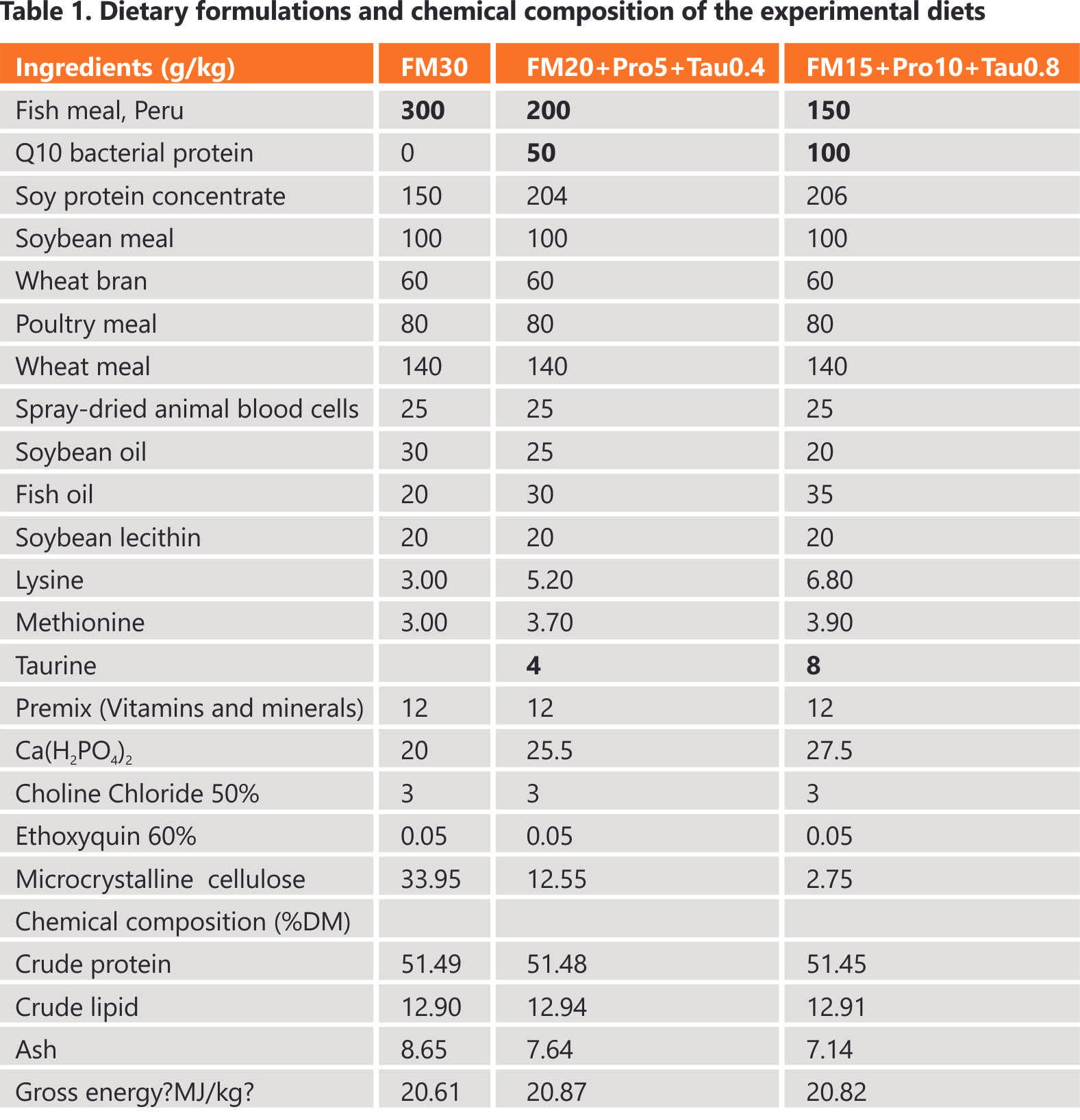 All diets were formulated with consistent energy and protein levels (Crude Protein ~51.5%, Crude Lipid ~12.9%) and extruded into 4.0mm pellets and stored at room temperature (formulation shown in table 1). Feeding occurred twice daily, started with an initial feeding rate of 3% body weight and later on feeding rates were adjusted based on appetite.
Water Quality Control
- pH: 7.0–7.5
- Temperature: 24–26°C
- DO: 7–8 mg/L
- Ammonia and nitrite <0.1 mg/L
After 8 weeks, experimental fish were fasted for 24 hours prior to sampling and evaluated on growth performance, blood parameters, liver health, and antioxidant capacity were evaluated.
Results: Growth Maintained, Health Improved
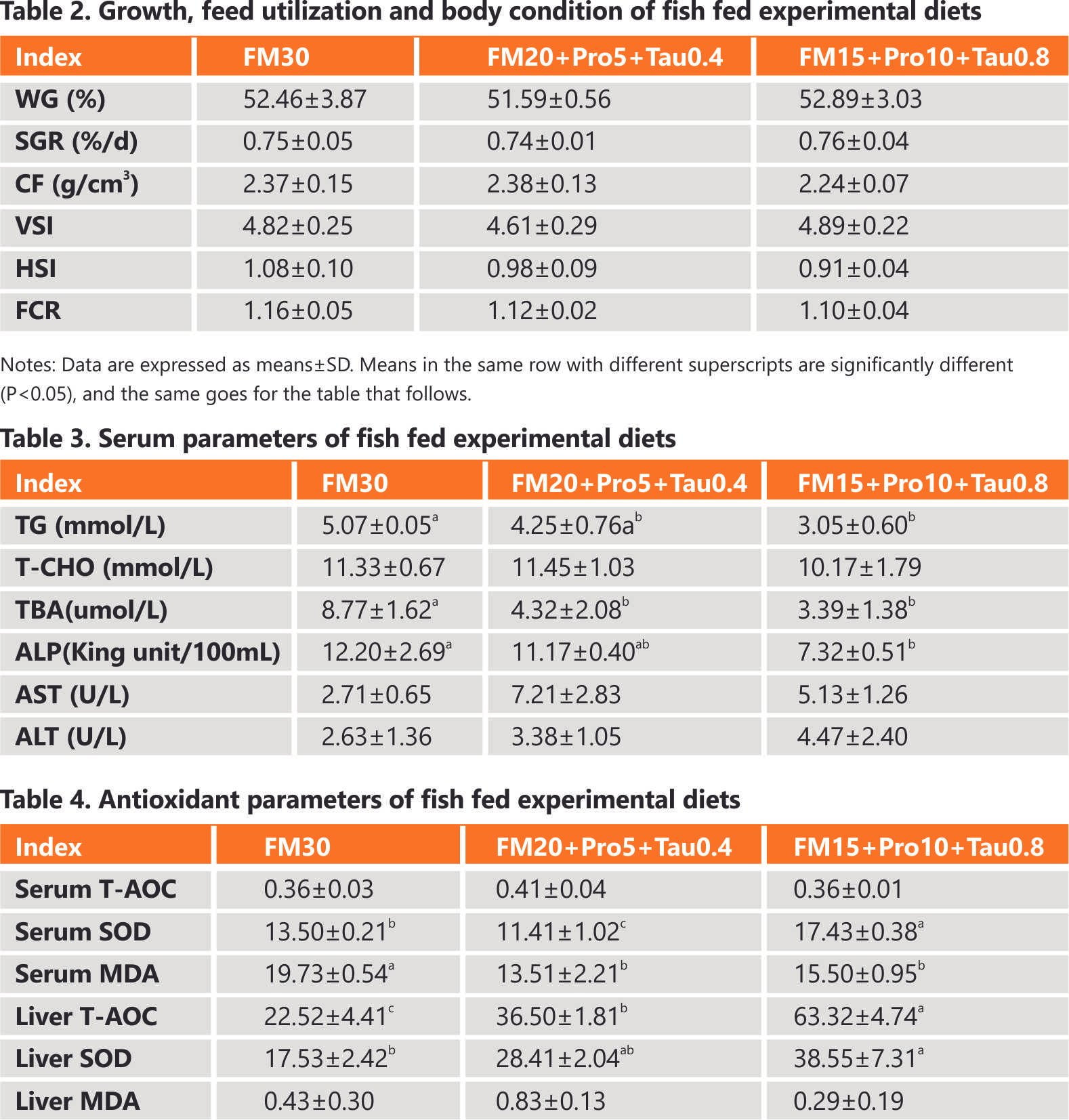
No significant differences were observed among groups in weight gain rate (WG), specific growth rate (SGR), condition factor (CF), viscerosomatic index (VSI), hepatosomatic index (HSI) or feed conversion ratio (FCR) (P>0.05).
Growth and Feed Utilization
Taurine supplementation led to decreasing trends in plasma triglycerides (TG), total bile acids (TBA), and alkaline phosphatase (ALP). Specifically, the 0.8% taurine group showed significant reductions in TG, TBA, and ALP levels compared to the control group (P < 0.05), indicating improved lipid metabolism and potential liver protection. Other parameters showed no significant differences (P > 0.05) (as shown in table 2).
 Liver Function & Lipid Metabolism
Compared with the control group, the plasma malondialdehyde (MDA) content in taurine supplementation groups were significantly lower(P< 0.05), and the 0.8% taurine group showed significantly higher superoxide dismutase (SOD) activity in both plasma and liver, along with markedly enhanced total antioxidant capacity (T-AOC) in liver (P < 0.05) (as shown in table 3).
Antioxidant Status
The group with 0.8% taurine showed significantly higher superoxide dismutase (SOD) activity and total antioxidant capacity (T-AOC), confirming improved oxidative resilience (as shown in table 4).
Conclusion: A Viable Path to Sustainable Aquafeeds
The integration of Q10 bacterial protein, soy protein concentrate, and taurine into Largemouth bass diets enabled a 50% reduction in fishmeal without negatively impacting growth or feed efficiency. Moreover, taurine supplementation significantly improved liver health and oxidative stress resilience.
As this study demonstrates, taurine plays a central role in the next generation of aquafeeds. When paired with high-quality, non-traditional proteins like Q10 bacterial protein, taurine becomes essential for maintaining fish performance and promoting long-term sustainability.
With its multi-functional benefits—from liver protection to appetite stimulation and oxidative stress reduction—taurine is poised to drive the green upgrading of aquatic feeds, transforming the future of aquaculture.
By Chen ying, Animal Nutrition Application Service Center, Zhejiang NHU
For further information, the author can be contacted at ch.ying@cnhu.com