


Page 28 - Think Grain Think Feed - July 25
P. 28
www.benisonmedia.com ARTICLE shown in Fig. 4. 54.40±6.290 mg/dL; T4: acid synthesis by the liver. observed in FWP-fed groups as a dietary additive. This is Conclusion www.benisonmedia.com
Think Grain Think Feed - Volume 11 | Issue 9 | July 2025
Think Grain Think Feed - Volume 11 | Issue 9 | July 2025
51.75±6.316 mg/dL; T3:
(e.g., T2: 22.65±0.240×10³
This effect is enhanced in
consistent with the role of
Specifically, the lowest serum
This study concludes that
49.50±8.138 mg/dL), "bad"
hydrolyzed whey peptides
/uL) compared to the control
whey protein hydrolysates
cholesterol was found in the
supplementing broiler diets
LDL cholesterol and VLDL
(T1: 22.26±0.336×10³ /uL),
due to changes in sulfhydryl
and BCAAs in maintaining
T3 group (fed <10 kDa
with fermented cheese whey
Permeate) at 123.75±9.746
immune response, likely due
highest in the control group
that facilitate hydrogen bond
mg/dL, followed by T4 (>10
metagenomic analysis of
synergistically improves
(T1: LDL 92.81±14.174
interaction with bile salts.
to the immunoregulatory
cecal samples, encompassing
kDa Retentate) at cholesterol levels were groups and disulfide bonds indicating an enhanced tissue health. A peptide (FWP) fractions
growth performance and
125.89±8.855 mg/dL, and T2 mg/dL, VLDL 17.90±1.089 These findings are consistent properties of whey peptides. 1.2 million paired reads overall health. FWP
(<3 kDa Permeate) at mg/dL) compared to the with previous research Although mean corpuscular across 8 samples, identified supplementation
143.21±10.451 mg/dL, all FWP-fed groups (T2: LDL demonstrating that dairy volume (MCV) and mean 1065 unique Amplicon significantly reduced serum
significantly lower than the 74.89±15.667 mg/dL, VLDL proteins, particularly whey, corpuscular hemoglobin Sequence Variants (ASVs). cholesterol, triglyceride, and
control group (T1) at 14.46±0.975 mg/dL; T3: LDL contribute to satiety and (MCH) showed no significant While alpha and beta blood glucose levels.
165.09±9.327 mg/dL. 62.14±10.569 mg/dL, VLDL improved lipid profiles. changes, the numerically diversity indices showed no Furthermore, FWP exhibited
Triglyceride levels were also 13.07±2.375 mg/dL; T4: LDL Beyond lipid profiles, this higher values in FWP groups statistically significant shifts no adverse effects on broiler
lower in FWP-fed groups: T3 62.41±16.181 mg/dL, VLDL study also investigated the suggest an improved in overall microbial organs (heart and liver) and,
(65.33±5.833 mg/dL), T4 14.32±1.757 mg/dL). Despite effects of FWP on broiler capacity to resist stress. populations between groups,
(71.60±3.956 mg/dL), and T2 numerical differences, no blood parameters and gut Additionally, significantly FWP notably modulated gut notably, influenced white
(72.47±5.778 mg/dL), statistically significant metagenomics. While red higher platelet counts were microbiota composition at blood cell (WBC) counts,
compared to T1 variations were observed for blood cell (RBC) counts observed in FWP-fed groups the phylum and genus levels, likely due to their immune-
(85.71±4.128 mg/dL). Total LDL and VLDL cholesterol remained within the normal (e.g., T4: 126.25±0.854 /µl) despite the short 7-day regulating and anti-
lipids were significantly across all groups. physiological range and compared to the control (T1: administration period. For inflammatory properties. The
higher in T1 (625.83±22.97 The observed reduction in showed no significant 120.00±1.291 /µl), potentially study highlights FWP's
mg/dL) compared to T2 cholesterol, triglyceride, and difference, the FWP-fed linked to increased levels of instance, Bacteroidota, positive impact on
(559.80±28.562 mg/dL), T4 total lipids in FWP-fed groups numerically exhibited vitamins (like B12) and folic Campylobacterota, cholesterol activity and its
(528.55±29.697 mg/dL), and groups is likely attributed to higher RBC counts compared acid enhanced by Desulfobacterota_I, and role beyond mere nutrition,
T3 (514.73±39.140 mg/dL). the strong binding capacity to the control (T1: fermentation. Furthermore, Proteobacteria were higher offering beneficial
While HDL, a beneficial of whey peptides with bile 2.20±0.107×10⁶ /uL; T4: FWP supplementation in T3 (<10 kDa permeate), physiological effects during
cholesterol, remained largely acids, which decreases 2.39±0.083×10⁶ /uL). significantly lowered blood whereas Firmicutes were broiler growth.
similar across all groups (T1: intestinal lipid absorption Crucially, a significant glucose levels in broiler more abundant in T4 (>10 While promising for large-
57.48±7.016 mg/dL; T2: and promotes cholesterol increase (p < 0.05) in white chickens, with T4 exhibiting kDa retentate). Importantly, scale antibiotic-free broiler
excretion and de novo bile blood cell (WBC) counts was the lowest at 182.82±1.57 beneficial bacterial production and potential
mg/dL compared to T1 at communities were effectively human functional food or
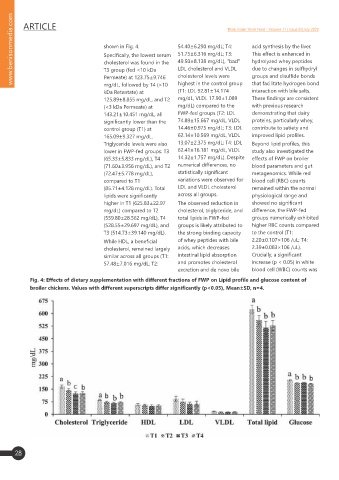
Fig. 4: Effects of dietary supplementation with different fractions of FWP on Lipid profile and glucose content of
204.27±3.34 mg/dL, likely supported, and potentially medicinal applications,
broiler chickens. Values with different superscripts differ significantly (p<0.05), Mean±SD, n=4.
due to the insulinogenic harmful bacterial loads, such limitations include the need
effects of branched-chain as Alphaproteobacteria, for standardizing FWP
amino acids (BCAAs) Campylobacteria, Clostridia, processing parameters for
abundant in whey protein, or and Helicobacter, were large-scale production and
its influence on incretin observed to be lower in addressing the stability of
hormones. These findings some FWP-treated groups, the liquid FWP product,
suggest FWP's potential in
notably T4, as compared to which requires refrigeration
glycemic control and
control. This suggests FWP's and has a shelf life of up to
immune system support,
antimicrobial properties and three weeks. Future research
especially for individuals with should focus on these
its ability to modulate the
compromised immune aspects, as well as evaluating To read complete article, please
gut microbiome, making it a
function or glucose FWP's effect on egg refer to the following link
valuable intervention for gut https://go.nature.com/4m0oDKL
metabolism issues. production and conducting
health. Overall, despite a or scan here
Histological analysis of the further clinical research in
shorter administration
heart, intestine, and liver humans.
period, FWPs demonstrated
revealed no significant organ Disclaimer: The article is reproduced from
comparable beneficial effects original article titled “Influence of fermented
toxicity or abnormal on gut microbiota to the 42- whey protein fractions on the growth
morphology in FWP- performance, haematological traits, serum
day commercial probiotic biochemistry, faecal and caeca microbiota of
supplemented groups, broiler chickens” in Nature Briefing:
and immunomodulator Translational Research.
confirming the safety of FWP
regimen.
28 29

