Analytical Twin: The Bridge Between Digital Automation and the Autonomous Feed Mill
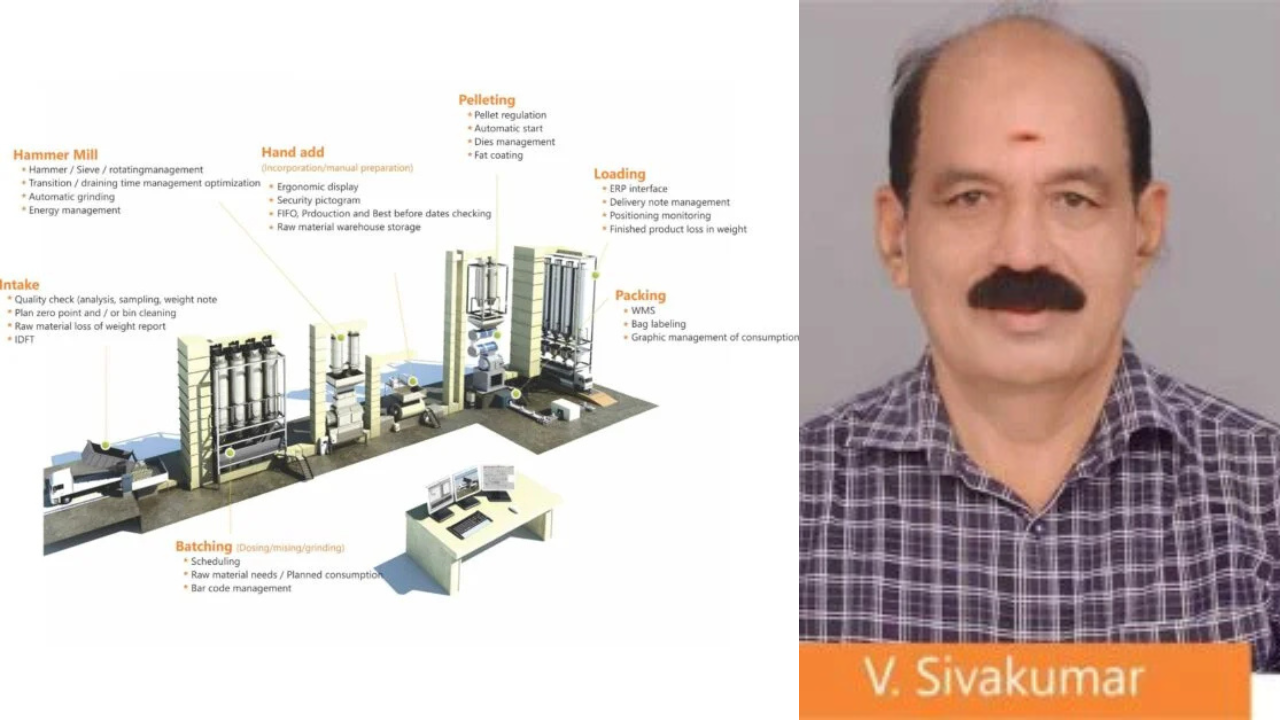
Modern feed mills have embraced PLCs, SCADA, VFDs, IoT sensors, and Digital Twin technologies to improve throughput, consistency, and operational visibility. While these technologies have transformed automation, they remain largely equipment-centric, focusing on machine control rather than engineering intelligence.
Automation has made feed mills faster. Digitalization has made them more connected. Yet neither can explain why a process deviates, where losses occur, or how to optimize performance.
Current digital systems cannot interpret mass balance deviations, moisture dynamics, thermal behaviour, energy inefficiencies, or quality-related process interactions. Bridging this gap requires a new layer of intelligence—the Feed Mill Analytical Twin.
Automation vs Engineering Intelligence
Automation systems are designed to maintain set points, execute programmed sequences, and ensure safe operation. They excel at controlling machines but cannot understand the engineering relationships between different process stages.
Consider a conventional hammer mill. It can:
- Maintain motor speed
- Regulate feeder rate
- Monitor motor load
- Generate alarms
An Analytical Twin, however, transforms the same machine into an engineering decision system by enabling it to:
- Interpret formulation-specific grinding requirements
- Predict particle size distribution based on ingredient characteristics
- Adjust for moisture variation
- Coordinate grinding with batching, mixing, and pelleting operations
- Calculate grinding energy consumption per tonne and its downstream impact
This marks the transition from control logic to engineering logic.
Why Existing Digital Systems Fall Short
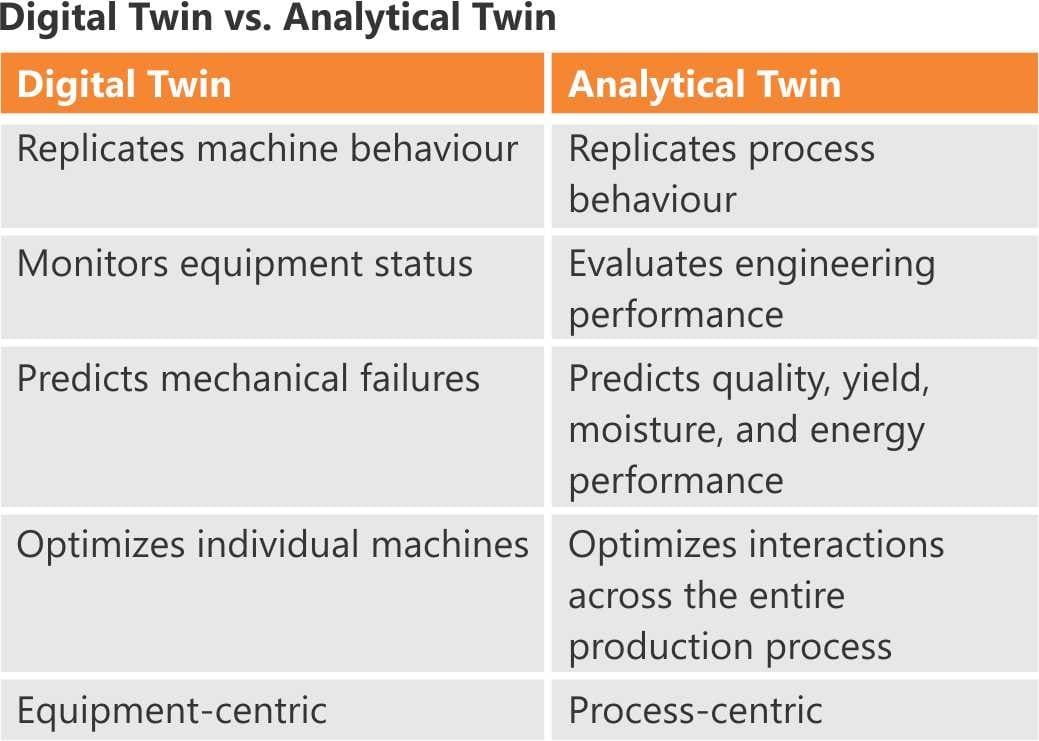
PLCs control equipment. SCADA visualizes data. Digital Twins replicate machine behaviour.
However, none of these systems can answer critical engineering questions such as:
- Where did the unexplained 1–2% material loss occur?
- Which process caused unexpected moisture loss or absorption?
- Why did conditioning temperature fluctuate despite stable steam pressure?
- Why is energy consumption per tonne increasing during peak production?
- Which processing stage affected nutrient uniformity?
- Why did pellet durability decline even though die specifications remained unchanged?
Answering these questions requires engineering models—not automation logic.
A Digital Twin knows the machine. An Analytical Twin understands the manufacturing process.
 Engineering Models Inside the Analytical Twin
The Analytical Twin integrates multiple engineering models that continuously analyse and verify process performance across the feed mill, including:
- Mass Balance Model – Detects material losses, spillage, carryover, and yield variations.
- Moisture Balance Model – Tracks moisture movement during grinding, mixing, conditioning, pelleting, and cooling.
- Heat Balance Model – Evaluates thermal efficiency and steam utilization during conditioning, pelleting and cooling.
- Energy Balance Model – Monitors energy consumption (kWh/tonne) and identifies process inefficiencies.
- Grinding Performance Model – Predicts particle size distribution based on ingredient hardness, moisture, screen size and rotor dynamics.
- Mixing Verification Model – Assesses coefficient of variation (CV), ingredient distribution, mixing time and batch uniformity.
- Steam Utilization Model – Evaluates steam-to-moisture conversion efficiency, steam leakage, condensate return and conditioning effectiveness.
- Conditioning Efficiency Model – Correlates dwell time, temperature, moisture, and shear with pellet quality.
- Pellet Quality Prediction Model – Predicts Pellet Durability Index (PDI) using die parameters, formulation characteristics, conditioning profile and mechanical load.
- Cooling Performance Model – Detects over- or under-cooling by monitoring moisture and temperature reduction.
- Nutritional Verification Model – Monitors nutrient retention, thermal degradation, and feed uniformity, supported by farm feedback.
- Feed Traceability Model – Ensures complete traceability from feed mill to farm.
Together, these models convert raw sensor data into engineering knowledge, enabling real-time diagnosis, prediction, and decision-making.
Three Levels of Intelligence in Feed Manufacturing
The evolution of feed manufacturing can be viewed in three distinct stages:
Level 1 – Data Intelligence (Digital Twin)
- Data acquisition
- Trend visualization
- Alarm generation
- Equipment monitoring
Level 2 – Engineering Intelligence (Analytical Twin)
- Engineering calculations
- Mass, moisture, heat & energy balance verification
- Root cause diagnosis
- Predictive quality and yield modelling
Level 3 – Autonomous Intelligence (Future Feed Mill)
- AI driven optimization
- Automatic process adjustments within safe operating limits
- Continuous learning from historical data
- Self optimizing process loops
This progression transforms data into information, information into engineering knowledge, and engineering knowledge into intelligent decisions.
From Automation Logic to Engineering Logic
Traditional automation follows a straightforward path:
Sensor → PLC → SCADA → Operator Decision
An Analytical Twin introduces an engineering layer:
Sensor → PLC → Engineering Models → Analytical Twin → AI Engine → Engineering Recommendation → Operator or Autonomous Control
Instead of simply monitoring machines, the system interprets process behaviour, identifies root causes, predicts outcomes, and recommends corrective actions.
Why Engineering Intelligence Matters
Even highly automated mills continue to face:
- Material losses during storage and transfer
- Grinding inefficiencies caused by raw material variability
- Moisture losses during transfer and cooling
- Poor steam utilization due to condensate issues
- Conditioning instability resulting from inconsistent raw materials
- Pellet quality fluctuations despite stable die parameters
- Energy wastage during peak load conditions
- Unexplained yield losses across the production process
Adding more sensors or dashboards will not solve these challenges. What is needed is a deeper understanding of the engineering relationships between process variables.
The Four Evolutions of Feed Manufacturing
The industry has progressed through four distinct phases:
- Mechanization (1940s): Mechanical equipment replaced manual labour.
- Automation (1980s): PLCs and VFDs improved consistency, productivity, and safety.
- Digitalization (2010s): SCADA, IoT, and Digital Twins enabled real-time monitoring and predictive maintenance.
- Engineering Intelligence (2030s): Analytical Twins transform operational data into engineering decisions and autonomous process optimization.
The Analytical Twin represents the foundation of the next-generation autonomous feed mill.
The Autonomous Feed Mill
Tomorrow’s feed mills will no longer be judged by the number of PLCs, sensors, or dashboards they possess. Instead, their success will depend on their ability to answer five critical engineering questions:
- Why did the process deviate?
- Where did the loss occur?
- Which variable caused the quality shift?
- How can the process optimize itself?
- What engineering action is required immediately?
The Analytical Twin provides these answers by transforming machine data into engineering knowledge—and engineering knowledge into intelligent, autonomous action.
Conclusion
Automation made feed mills faster. Digitalization made them connected. Engineering intelligence will make them autonomous.
The Feed Mill Analytical Twin is far more than another digital tool—it is the engineering brain of the future feed mill. By integrating engineering models with real-time process data, it enables consistent product quality, higher yields, improved energy efficiency, and smarter operational decisions. As India’s feed industry advances toward autonomous manufacturing, the Analytical Twin will become a critical foundation for sustainable, intelligent, and process-driven feed production.
Author:
- Sivakumar is the founder of Feed Tech Engineering, Coimbatore, and writes on feed mill systems, grain storage engineering, and digital process intelligence in the Indian feed industry.
By V. Sivakumar, Founder, Feed Tech Engineering, Coimbatore