This article is based on a telephonic interaction with the author and has been edited by the Think Grain Think Feed editorial team for clarity and length.
Antimicrobial resistance (AMR) – A challenge to animal health, public health, and sustainable food production. While antibiotics remain indispensable for treating bacterial infections, their indiscriminate use has accelerated the development of resistant pathogens. Addressing this challenge requires more than reducing antibiotic consumption—it calls for rethinking livestock health within a broader ecological framework.
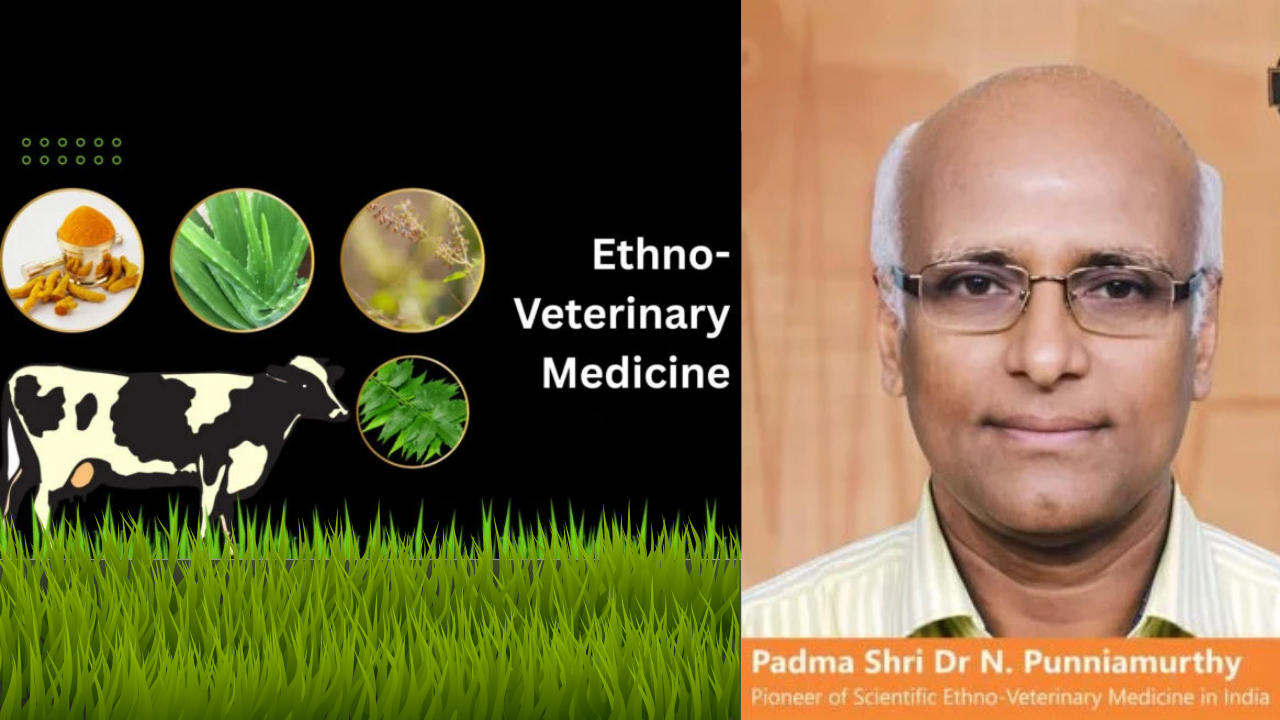
Ethno-Veterinary Medicine (EVM) is often perceived as a collection of herbal remedies. However, its significance extends far beyond traditional medicine. It represents an integrated approach that combines ecological sustainability, preventive healthcare, scientific validation, and responsible antimicrobial stewardship.
“Ethno-Veterinary Medicine does not replace antibiotics; it helps conserve antibiotics. That is the essence of antimicrobial stewardship.”
Livestock Health Begins with Ecosystem Health
Modern agriculture, industrialization, and urbanization have transformed food production, but they have also increased environmental pollution and chemical burden on ecosystems. While food safety discussions frequently focus on residue-free milk, meat, and eggs, equal attention must be given to the ecological systems that support livestock production.
Healthy soils are living ecosystems populated by billions of microorganisms that regulate nutrient cycling, plant growth, and overall ecosystem resilience. Today, microbiome science clearly demonstrates that these microbial communities form the foundation of agricultural productivity.
Livestock are equally dependent on these microbial ecosystems. Their digestive tract functions as an extended microbial ecosystem, while their dung and urine eventually return nutrients and microorganisms back to the soil. Therefore, truly sustainable livestock production requires not only residue-free animal products but also biologically healthy manure that enriches rather than degrades soil health.
This ecological perspective places livestock at the centre of sustainable agriculture and reinforces the importance of preventive healthcare approaches.
EVM: More Than Herbal Medicine
EVM should not be viewed simply as the use of medicinal plants. Instead, it forms an important component of circular livestock production.
The National Dairy Development Board (NDDB) has demonstrated that scientifically validated herbal formulations can improve animal health while reducing unnecessary chemical interventions. Importantly, these practices contribute to cleaner dung and urine, which are subsequently recycled into agricultural systems through composting and biogas slurry.
As these organic inputs return to the soil, they support healthier microbial populations and strengthen the ecological cycle.
This philosophy aligns closely with India’s vision for natural farming, where healthy livestock, healthy soils, and healthy food production become mutually reinforcing.
Conserving Antibiotics for Future Generations
Antibiotics remain essential for treating bacterial infections and saving animal lives. However, decades of unnecessary and indiscriminate use have placed these invaluable medicines at risk.
Every unnecessary antibiotic treatment increases selection pressure for antimicrobial resistance. Meanwhile, the development of new antibiotics has slowed considerably, making conservation of existing antibiotics more critical than ever.
EVM therefore serves as a complementary approach that reduces avoidable antibiotic use in suitable clinical situations while preserving antibiotics for cases where they are genuinely needed.
Science Behind the Traditional Knowledge
The greatest strength of Ethno-Veterinary Medicine programme is that it has moved beyond traditional knowledge into evidence-based veterinary science.
Over the past decade, collaborative work involving NDDB, TANUVAS and TDU has generated one of the world’s largest field datasets on Ethno-Veterinary Medicine.
More than 12.5 lakh treatment cases have been digitally recorded and continuously monitored across multiple livestock production systems in India. This extensive database has enabled systematic evaluation of treatment outcomes under field conditions.
Scientific validation has not stopped at field observations. Researchers have applied the same methodologies used in conventional veterinary medicine, including in vitro and in vivo studies, to evaluate EVM formulations. Recent research published in Microbial Pathogenesis (December 2025) further strengthens the scientific foundation of these formulations.
Preliminary findings demonstrate encouraging clinical performance, with an average clinical success rate of approximately 84% under appropriate conditions.
Importantly, the evidence has also been independently evaluated. Studies conducted by the Centre for Science and Environment (Down To Earth) reported findings comparable to NDDB’s field data, adding further credibility to the approach.
An independent assessment by the Centre for Science and Environment (CSE) and Down To Earth found that ethnoveterinary medicine achieved an overall clinical success rate of over 80% across nearly 7.8 lakh livestock cases, demonstrating its potential to reduce unnecessary antibiotic use and strengthen India’s fight against antimicrobial resistance (AMR).
This growing body of scientific evidence has also contributed to international recognition, with Ethno-Veterinary Medicine being recommended as an important strategy within Global discussions on antimicrobial resistance reduction.
Designing a Truly Pan-Indian Model
Developing healthcare solutions for India’s livestock sector requires addressing enormous geographical, climatic, and socio-economic diversity. Recognising this challenge nearly two decades ago, the objective was never to develop region-specific remedies but to create a scalable national model.
Every EVM formulation was therefore standardized using around 10 commonly available spices and 15 perennial medicinal plants, deliberately avoiding rare, endangered, toxic, or difficult-to-source species. Widely available plants such as neem, tulsi, moringa, along with common household spices, were selected to ensure year-round availability, farmer accessibility, safety, and long-term sustainability.
“Scalability was built into the model from day one. We deliberately avoided rare plants, endangered, toxic, or difficult-to-source plants so that farmers anywhere in India could adopt it.”
The standardized EVM model is now being promoted across the country. Technical manuals and educational videos have been translated into 12 Indian languages, significantly improving last-mile adoption among livestock farmers.
This combination of scientific validation, practical simplicity, and nationwide accessibility makes EVM particularly well suited to India’s predominantly smallholder livestock systems.
Way Forward
India’s livestock sector will remain central to ensuring nutritional security for more than a billion people. Sustainable livestock production therefore demands approaches that simultaneously protect animal health, preserve antibiotic effectiveness, maintain soil health, and strengthen ecological resilience. Ethno-Veterinary Medicine offers precisely such an opportunity—not as a replacement for modern veterinary science, but as a scientifically validated complementary approach that integrates traditional knowledge with contemporary research.
“If India aspires to become a global leader in natural farming, livestock must remain at its centre—and Ethno-Veterinary Medicine should become an integral part of that journey.”
The future of livestock production depends not only on healthier animals, but also on healthier ecosystems, healthier soils, and responsible stewardship of antibiotics. By embracing evidence-based Ethno-Veterinary Medicine, India has the opportunity to build a resilient livestock sector that safeguards animal health, protects public health, and conserves one of modern medicine’s most valuable resources for generations to come.