
Suboptimal pigmentation of egg yolks and broiler carcasses is a common quality concern in commercial poultry production. Natural carotenoid sources such as yellow corn, marigold (Tagetes erecta) meal, and alfalfa meal are susceptible to seasonal variation in pigment content, oxidative degradation during storage, and thermal degradation during pelleting. These factors collectively compromise yolk and carcass pigmentation, frequently resulting in coloration that fails to meet commercial grading standards.
β-Apo-8′-carotenoic acid ethyl ester (apo-ester) and canthaxanthin are synthetic carotenoid feed additives approved for use in many countries, including India. Because of their consistent pigmentation efficacy and superior stability during feed processing, these additives effectively compensate for the limitations of natural carotenoid sources and are therefore extensively used in commercial compound feeds.
Introduction to Apo-ester and Canthaxanthin in Poultry Pigmentation
Apo-ester provides a stable golden-yellow base, contributing to uniform yolk pigmentation and improved carcass surface coloration. Canthaxanthin contributes an orange-red hue, enhancing yolk color saturation, Roche color fan scores, and shank pigmentation. When used together, the two carotenoids act synergistically to produce uniform golden-orange yolks and superior carcass appearance, consistently outperforming single-pigment supplementation in meeting commercial color standards[1].
- Tissue Deposition and Utilization of Apo-ester and Canthaxanthin in Poultry
As poultry cannot synthesize carotenoids de novo, egg yolk and carcass pigmentation depend entirely on the dietary supply of carotenoids. Once absorbed through the small intestine, carotenoids enter the bloodstream and are deposited in specific tissues, including the ovarian yolk, subcutaneous adipose tissue, and the keratinized layers of the shanks, where they determine the final pigmentation of poultry products[2].
Apo-ester and canthaxanthin possess high lipophilicity and bioavailability, enabling efficient absorption and deposition in lipid-rich tissues, contributing to stable pigmentation. In addition to their pigmentation properties, both carotenoids exhibit antioxidant activity due to their conjugated double-bond structure, helping protect pigments against lipid oxidation and improving color stability during feed processing and storage.
Feeding Trial Results
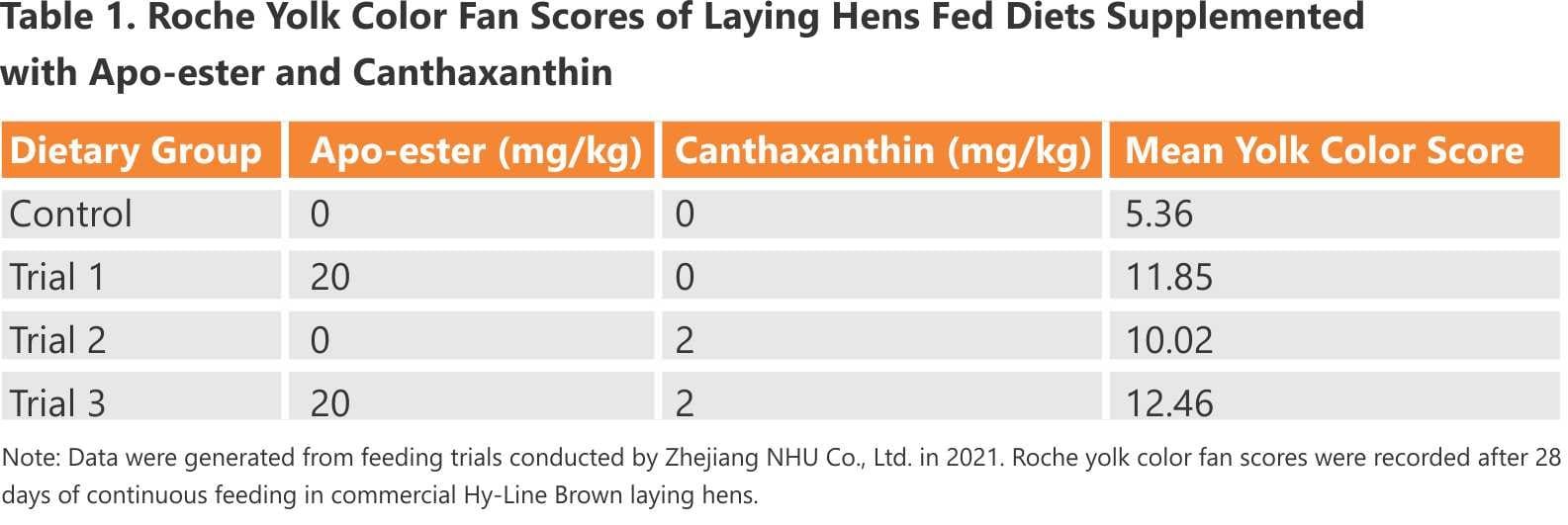
The feeding trial demonstrated that the combined supplementation of apo-ester and canthaxanthin produced the highest yolk color score (12.46), significantly outperforming both the control and single-carotenoid treatments. While apo-ester and canthaxanthin individually improved yolk pigmentation, their combined use delivered the most consistent and commercially desirable results. Importantly, supplementation had no significant effect on laying rate, egg weight, or feed conversion ratio, confirming that improved pigmentation was achieved without compromising bird performance.
Factors Affecting the Pigmentation Efficacy of Apo-ester and Canthaxanthin
 Although apo-ester and canthaxanthin provide consistent pigmentation, their effectiveness is influenced by several nutritional, genetic, processing, and management factors.
- Basal Pigment Level of Feed Ingredients
Natural carotenoids present in feed ingredients form the basal pigment level of poultry diets. However, pigment concentrations vary with corn maturity, ingredient quality, storage conditions, and dietary formulation. Such variability directly influences carotenoid deposition in tissues, resulting in inconsistent yolk and carcass pigmentation. Consequently, a fixed supplementation rate may not always deliver uniform pigmentation across different feed batches.
- Genetic Influence on Carotenoid Utilization
Bird genetics play an important role in carotenoid absorption and tissue deposition. Yellow-feathered broilers generally exhibit greater intestinal absorption, transport, and deposition of carotenoids than white-feathered broilers, resulting in superior skin, shank, and carcass pigmentation under similar dietary conditions.
- Impact of Feed Processing on Pigment Stability
Feed processing conditions, including pelleting temperature, pressure, and prolonged storage, can reduce the stability and biological activity of synthetic carotenoids. Unprotected apo-ester and canthaxanthin are susceptible to oxidation and thermal degradation, reducing their pigmentation efficacy. To overcome these challenges, microencapsulation technology is widely used to protect carotenoids during feed manufacture and storage while improving their stability and, in many cases, enhancing bioavailability.
- Husbandry Stress and Pigment Deposition
Environmental and management-related stress can impair lipid metabolism and adipose tissue development, both of which are essential for carotenoid absorption and deposition. Reduced lipid availability limits carotenoid transport in the bloodstream and decreases pigment deposition in target tissues, leading to poorer yolk and carcass pigmentation. These effects result from stress-induced metabolic disturbances rather than any reduction in the intrinsic efficacy of apo-ester or canthaxanthin.
Owing to their high bioavailability and efficient tissue deposition, apo-ester and canthaxanthin can partially offset these stress-related limitations thereby improving carotenoid retention in target tissues and supporting more consistent pigmentation, even under suboptimal production conditions.
Differentiated Supplementation Strategies for Targeted Egg Pigmentation
The complementary pigmentation properties of apo-ester and canthaxanthin enable nutritionists to develop tailored supplementation strategies for different egg market segments. By adjusting their inclusion levels, producers can achieve the desired yolk color while optimizing feed costs and ensuring consistent product quality.
- Fresh Eggs: Canthaxanthin-Dominant Economical Strategy
For commercial fresh eggs, where moderate yolk color intensity and cost efficiency are the primary objectives, canthaxanthin alone is generally sufficient to meet standard market requirements. A low inclusion of apo-ester may be used to improve color uniformity and fine-tune the golden-yellow hue without significantly increasing pigmentation costs.
- Premium Branded Eggs: High Apo-ester–Low Canthaxanthin Strategy
Premium egg brands demand superior yolk color intensity, excellent batch-to-batch consistency, and stable pigmentation despite variations in feed ingredients and processing conditions. Fluctuations in natural carotenoid levels can result in inconsistent yolk color. A formulation with a higher level of apo-ester provides a stable golden-yellow base that minimizes this variability, while a lower inclusion of canthaxanthin enhances the orange-red hue and overall color intensity. This combination is particularly suitable for premium egg products that require consistent pigmentation even after thermal processing.
Conclusion
Consistent poultry pigmentation depends on multiple factors, including dietary carotenoid supply, bird genetics, feed processing, and farm management. Apo-ester and canthaxanthin effectively overcome many of the limitations associated with natural carotenoid sources by providing superior bioavailability, processing stability, and complementary pigmentation characteristics.
Whether used individually or in combination, these synthetic carotenoid feed additives enable nutritionists and feed manufacturers to design cost-effective pigmentation programs tailored to specific production objectives. Their strategic application helps deliver uniform yolk and carcass pigmentation, improve product quality, and meet the diverse requirements of commercial and premium poultry markets.
References: [1]Wang,Zhaoping,Sun, et al. Effect of microencapsulated canthaxanthin and apo-ester on egg yolk color and antioxidant capacity in laying hens[J]. Poultry Science, 2024, 103(12): 104302.
[2]H. Hencken. Chemical and physiological behavior of feed carotenoids and their effects on pigmentation.[J]. Poultry Science, 1992, 71 4.
By Mengying Li, Research and Development Manager, Zhejiang NHU