 In India, most broiler diets rely heavily on corn and soybean meal, with corn often making up two-thirds of the formulation. While these ingredients offer significant energy and protein, broilers face physiological limitations: due to limited endogenous enzyme production and gastrointestinal inefficiencies, they cannot fully digest or extract nutrients from the diet. Consequently, a significant portion of feed energy remains unutilized, leading to reduced feed efficiency and economic losses.
To address this, exogenous enzymes—particularly xylanases—are commonly used to break down non-starch polysaccharides (NSPs), which are otherwise indigestible and hinder nutrient absorption. However, corn presents a unique challenge due to its NSP composition and high inclusion rates in feed formulations.
 The Role of NSPs in Corn-Soy Diets
Although corn contains less total NSP than soybean meal, its high inclusion amplifies its overall anti-nutritional effect. NSPs such as arabinoxylans, β-glucans, mannans, and galactomannans in corn-soy diets can interfere with nutrient utilization by increasing intestinal viscosity and limiting the release of entrapped nutrients. These inefficiencies may account for the loss of up to 400–450 kcal/kg of metabolizable energy, primarily from fat, protein, and starch.
 While the efficacy of xylanase in wheat- and rye-based diets is well-established (2), its utility in corn-heavy diets has been less certain. This is largely due to the structural characteristics of NSPs in corn, which tend to be more insoluble and less responsive to standard xylanases.
GH11 Xylanase: A Structural Advantage
Feed represents the single largest cost in poultry production, accounting for up to 70% of total costs. As a result, reducing feed costs without compromising performance remains a top priority for the industry. Xylanase is one effective way to achieve lower feed costs by reducing viscosity and releasing nutrients.
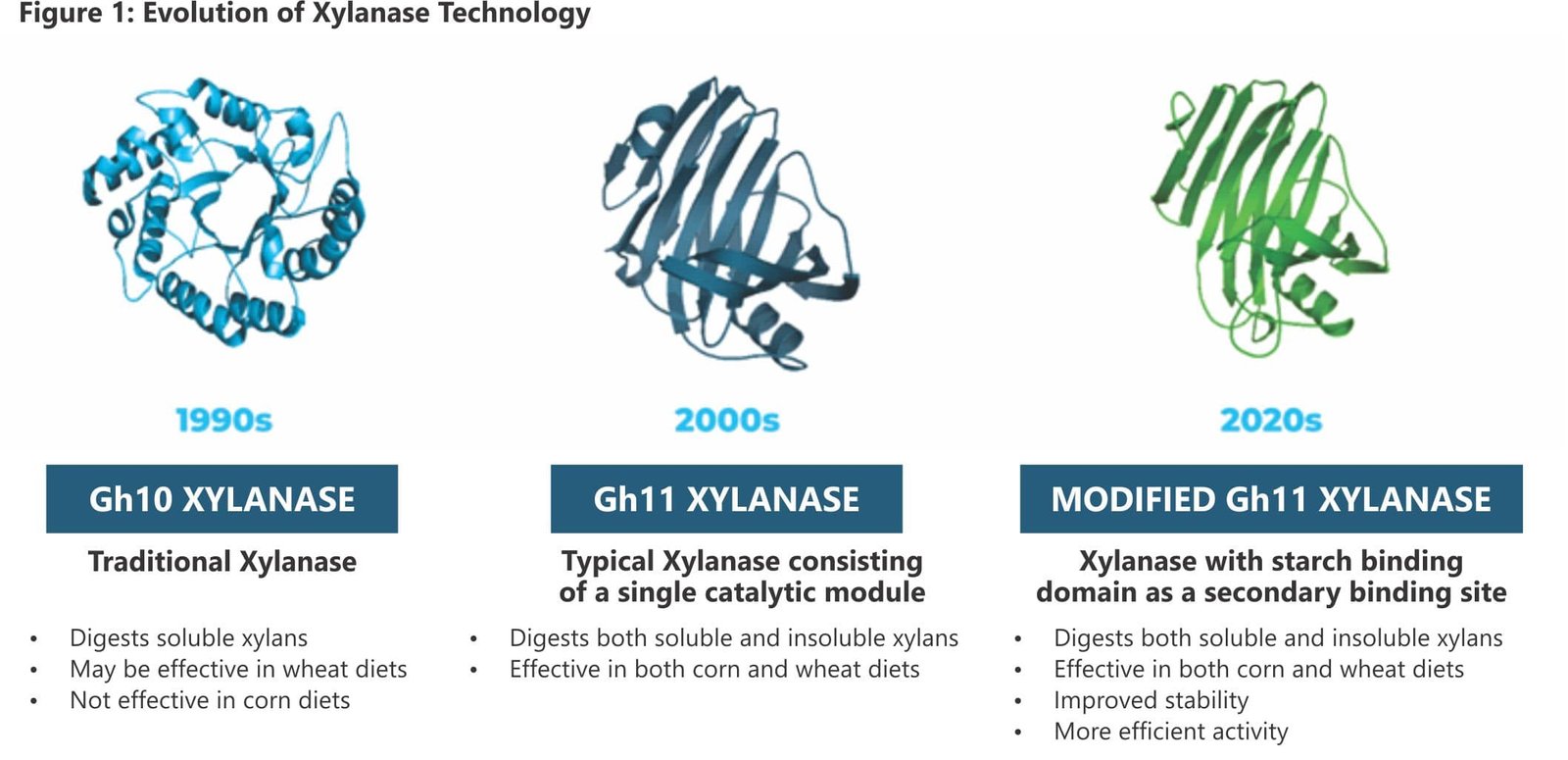
 Xylanases are categorized into glycoside hydrolase families based on their structure and activity—primarily GH10 and GH11. GH10 xylanases are effective in breaking down soluble xylans and reducing viscosity in wheat-based diets, but often show limited action in corn-based diets where NSPs are predominantly insoluble.
In contrast, GH11 xylanases are characterized by a single catalytic domain and have been shown to degrade both soluble and insoluble xylans. Their structural conformation allows greater activity on insoluble substrates, making them more suitable for corn-soy diets where unlocking energy from insoluble NSPs is critical.
Some modified GH11 xylanases – endo-1,4-beta-xylanase, derived from a unique gene in a naturally occurring fungal microorganism, features a starch binding domain as a secondary binding site for greater catalytic activity, supports degrading of both soluble and insoluble xylans and offers consistent results (as shown in Figure 1).
Its thermostability, low-pH resistance, and pump-like structure help ensure the enzyme performs reliably across feed manufacturing and in vivo conditions. Unlike traditional GH10 enzymes, this modified GH11 xylanase was specifically optimized through trials using corn-based diets, making it a better fit for markets like India.
Comparative Enzyme Efficacy
Recent studies comparing different xylanase types have highlighted significant differences in the speed and extent of NSP degradation. In a comparative hydrolysis study using substrates like corn, rice bran, and sorghum, one commercially available GH10 enzyme degraded 10% of insoluble xylans in five hours. A commercial GH11 enzyme reached 20% degradation in the same time frame. Meanwhile, a modified GH11 xylanase achieved 20% degradation in just one hour, indicating a more rapid and potentially more effective mode of action in the gastrointestinal tract (as shown in Figure 2).
Rapid enzymatic action is especially relevant in poultry, where feed retention time in the gut is limited. Enzymes must act quickly to release entrapped nutrients before excretion.
Broiler Trial Insights: Performance Under Reduced Energy Conditions
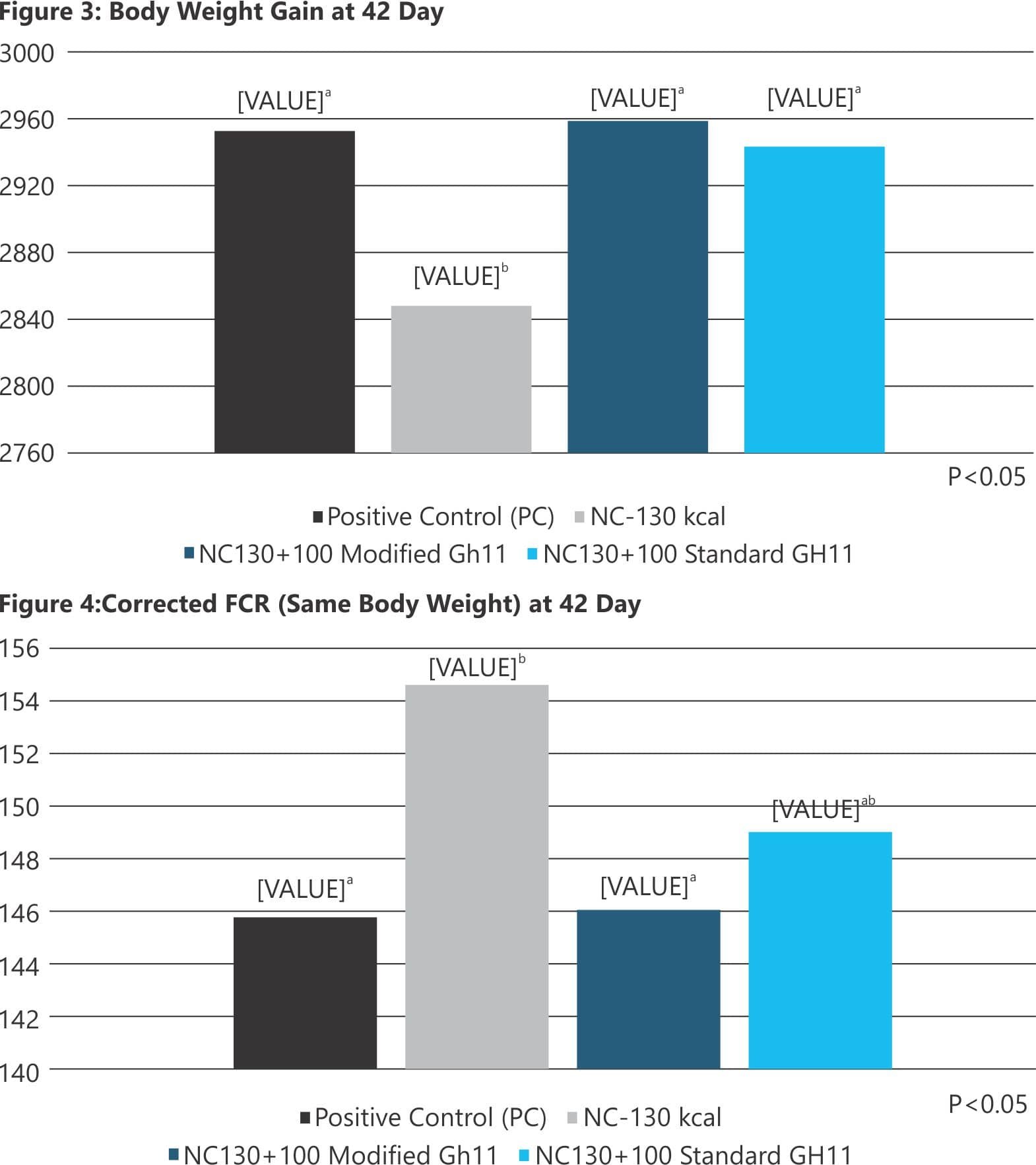
In a 2024 performance trial conducted under Indian field conditions, 432 Cobb broilers were fed a corn–soybean meal diet with 130 kcal/kg less metabolizable energy than the standard formulation over a 42-period period. Birds were divided into two groups: one received a standard GH11 xylanase, while the other was fed a modified GH11 xylanase, both at 100 grams/ton of feed.
At 42 days, the group receiving the modified GH11 xylanase showed improved performance metrics, including higher body weights (BW) and lower feed conversion ratios (FCR), despite the reduction in dietary energy (as shown in figure 3 & 4). These findings suggest that strategic enzyme selection can mitigate the negative effects of lower energy density in feed, supporting both consistent performance and cost efficiency.
Conclusion: Enzyme Selection for Corn-Soy Optimization
As feed costs continue to dominate the economics of poultry production, maximizing nutrient utilization remains a top priority. Xylanases, particularly those from the GH11 family with enhanced activity on insoluble xylans, offer promising solutions for improving nutrient availability in corn-soy diets.
Not all xylanases are equally effective in all diets, and enzyme choice should reflect the specific challenges posed by local feed formulations. When tailored appropriately, xylanase supplementation can support improved feed efficiency, consistent growth performance, and better overall return on investment in poultry production.
Disclaimer: Modified GH11 xylanase is a product of NOVUS. For more information, please connect with team at info@novusint.com
References are available upon request.
by Dr. Koushik De, Sales Director, Poultry-SCA, NOVUS