


Page 27 - Think Grain Think Feed - Noc 2025 Issue
P. 27
www.benisonmedia.com  CONFERENCE OUTCOMES  Think Grain Think Feed - Volume 12 | Issue 1 | Nov 2025  Think Grain Think Feed - Volume 12 | Issue 1 | Nov 2025  market demand. Accurate breeding records   www.benisonmedia.com


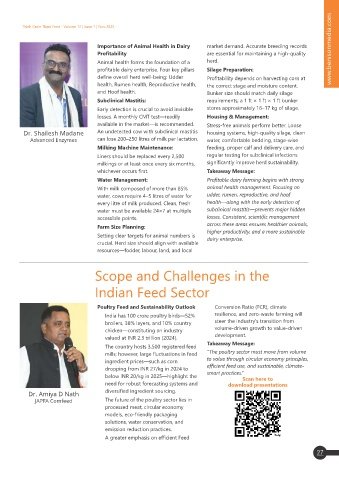
                                   Importance of Animal Health in Dairy
 Lessons from Feed & Dairy
                                   Profitability
                                                                          are essential for maintaining a high-quality
                                                                          herd.
                                   Animal health forms the foundation of a
 Conference 2025
                                                                          Silage Preparation:
                                   profitable dairy enterprise. Four key pillars
                                   define overall herd well-being: Udder
                                   health, Rumen health, Reproductive health,
                                                                          the correct stage and moisture content.
                                   and Hoof health.                       Profitability depends on harvesting corn at
                                                                          Bunker size should match daily silage
 Dairy Farm Profitability          Subclinical Mastitis:                  requirements; a 1 ft × 1 ft × 1 ft bunker
                                   Early detection is crucial to avoid invisible   stores approximately 16–17 kg of silage.
 Dairy Farming Innovation: A Tool for   ·  Consistent nutrition significantly   losses. A monthly CMT test—readily   Housing & Management:
 Sustainable Dairy Farming  enhances digestibility, milk quality, and   available in the market—is recommended.   Stress-free animals perform better. Loose
 ·  Low-cost, integrated dairy farming   overall milk yield.  Dr. Shailesh Madane  An undetected cow with subclinical mastitis   housing systems, high-quality silage, clean
 models—combining breeding, manure   ·  Aflatoxin remains a critical challenge in   Advanced Enzymes  can lose 200–250 litres of milk per lactation.  water, comfortable bedding, stage-wise
 utilisation, and value-added product   silage-making; hydroponics provides a   Milking Machine Maintenance:  feeding, proper calf and delivery care, and
 development—represent the future of   nutrient-dense source of green fodder   Liners should be replaced every 2,500   regular testing for subclinical infections
 sustainable dairy operations.  and is a strong alternative.  milkings or at least once every six months,   significantly improve herd sustainability.
 ·  Affordable innovations such as crop-  Takeaway Message:  whichever occurs first.  Takeaway Message:
 residue flooring, grooming brushes   In dairy farming, cost is not the biggest   Water Management:  Profitable dairy farming begins with strong
 costing only INR 400, and low-cost   barrier—mindset and intent matter more.   With milk composed of more than 85%   animal health management. Focusing on
 cooling systems have enabled farmers   The right exposure and learning can   water, cows require 4–5 litres of water for   udder, rumen, reproductive, and hoof
 to scale their operations from small   accelerate farm growth dramatically.  every litre of milk produced. Clean, fresh   health—along with the early detection of
 Dr. S. Gaikwad
 Govind Dairy  units of 600 farms to more than 4,000   water must be available 24×7 at multiple   subclinical mastitis—prevents major hidden
 farms.                            accessible points.                     losses. Consistent, scientific management
                                                                          across these areas ensures healthier animals,
                                   Farm Size Planning:
                                                                          higher productivity, and a more sustainable
 Optimizing Dairy Productivity and   NDDB's Ration Balancing Programme:  Setting clear targets for animal numbers is   dairy enterprise.
                                   crucial. Herd size should align with available
 Profitability with Scientific Nutrition  ·  Implemented across more than 30,000
                                   resources—fodder, labour, land, and local
 ·  The nutritional needs of dairy animals   villages, covering 28 lakh animals.
 vary with physiological stages of   ·  Achieved an average increase of 300
 lactation. The ration of animals must   g/day in milk yield, INR 26/day
 contain the right proportion of protein,   additional profit, and a 13.7% reduction   Scope and Challenges in the
 energy, minerals, and vitamins.  in enteric methane emissions.
                                  Indian Feed Sector
 ·  Proper NDF (Neutral Detergent Fibre)   ·  In 1962, a digital tool was developed
 and ADF (Acid Detergent Fibre) balance   enabling farmers to enter milk yield,
 ensures healthy digestion and optimal   fat%, feeding details, etc., to instantly   Poultry Feed and Sustainability Outlook  Conversion Ratio (FCR), climate
 rumen function.  receive balanced ration   ·  India has 100 crore poultry birds—52%   resilience, and zero-waste farming will
                                                                            steer the industry's transition from
 Dr. N. R. Ghosh  ·  Rumen microbes supply up to 70% of a   recommendations.  broilers, 38% layers, and 10% country
 NDDB  cow's energy, making efficient rumen   Economic Benefits:  chicken—constituting an industry   volume-driven growth to value-driven
                                      valued at INR 2.3 trillion (2024).    development.
 fermentation essential for productivity.  ·  TMR feeding can improve profitability   Takeaway Message:
 ·  Current feeding patterns show that   by INR 35–40 per animal per day.  ·  The country hosts 3,500 registered feed   “The poultry sector must move from volume
                                      mills; however, large fluctuations in feed
 45–50% of diets rely on crop residues;   Takeaway Message:               to value through circular economy principles,
                                      ingredient prices—such as corn
 green fodder availability remains   High-quality green fodder is the most   efficient feed use, and sustainable, climate-
                                      dropping from INR 27/kg in 2024 to
 seasonal, while cattle feed penetration is   economical nutrition source. Feeding good-  smart practices.”
 Scan here to   still only 13–14%, indicating significant   quality fodder alone can improve   below INR 20/kg in 2025—highlight the   Scan here to
 download presentations               need for robust forecasting systems and    download presentations
 market potential.  profitability by INR 30–35 per animal per   diversified ingredient sourcing.
 ·  Unscientific feeding practices prevent   day. Scientific, balanced feeding is essential   Dr. Amiya D Nath  ·  The future of the poultry sector lies in
             JAPFA Comfeed
 animals from achieving their genetic   to unlock an animal's full potential.
                                      processed meat, circular economy
 potential. Green fodder quality and
                                      models, eco-friendly packaging
 digestibility play a crucial role in ration
                                      solutions, water conservation, and
 formulation.                         emission reduction practices.
                                   ·  A greater emphasis on efficient Feed

 26                                                                                                             27

