The major reason modern dairy cows often fail to achieve their genetic potential is inadequate nutrition—and, more specifically, a lack of understanding of the role of fibre in dairy cow feeding programmes.
The greatest challenge in maximizing a dairy cow’s potential is providing her with the nutrients she requires. In many cases, cows are not supplied with the right balance of nutrients to support the level of milk production they are genetically capable of achieving or to maintain optimum reproductive performance.
The problem with dairy feeding programmes is not limited to the level of protein or energy. The amount, quality and physical characteristics of fibre in the diet are equally important.
Fibre is perhaps one of the most misunderstood components of a dairy cow’s ration.
Too much fibre can limit feed intake, resulting in inadequate energy and protein intake. On the other hand, insufficient effective fibre can adversely affect rumen function, reduce cud chewing and compromise rumen health and feed intake.
A successful dairy feeding programme must therefore be built around adequate quantities of high-quality forage and effective fibre.
Fibre: A Component Under the Farmer’s Control
The fibre component of the dairy cow’s ration is primarily supplied through forages such as green fodder, dry fodder and silage. Unlike many purchased feed ingredients, the quality of forage is substantially influenced by the farmer’s decisions—from crop selection and cultivation to harvesting, conservation and storage.
The stage at which green fodder is harvested has a major influence on its nutritional value. Delayed harvesting generally increases dry-matter yield per unit of land, but it also increases fibre concentration and can reduce digestibility and the availability of protein and energy.
Therefore, harvesting fodder at the appropriate stage of maturity is critical to obtaining a good balance between yield, digestibility and fibre.
Grains and concentrates also contain some fibre, but the physical and functional characteristics of fibre are particularly important when considering forage-based fibre in the dairy cow’s ration. Adequate effective fibre is essential for normal rumen function, cud chewing and saliva production, which helps buffer the acids produced during rumen fermentation.
What Is Fibre?
The structural components of plant cell walls primarily include cellulose, hemicellulose and lignin. In practical feed evaluation, fibre is commonly described using measures such as Neutral Detergent Fibre (NDF), Acid Detergent Fibre (ADF) and lignin.
In India, crude fibre is still commonly reported in feed analysis. However, crude fibre is a relatively less precise measure of the fibre fractions that are important for evaluating forage quality and predicting animal performance.
Understanding ADF
Acid Detergent Fibre (ADF) primarily represents cellulose and lignin in the plant cell wall. As ADF increases, forage digestibility generally decreases because a greater proportion of the plant material becomes less readily available for digestion.
While these components contribute to the physical structure of the ration and are important for normal rumen function, lignin is largely indigestible, while cellulose can be digested to varying degrees by rumen microorganisms. Therefore, higher ADF levels generally indicate lower forage digestibility and lower energy availability.
A commonly used reference range for ADF in a total dairy ration is around 16–19%, although the appropriate level depends on forage quality, stage of lactation, milk production and the overall composition of the ration. A significant proportion of dietary ADF will typically come from green fodder, dry fodder and silage.
Understanding NDF
Neutral Detergent Fibre (NDF) includes hemicellulose, cellulose and lignin. NDF is particularly important because it influences dry-matter intake, rumen function and chewing activity.
NDF can be considered an indicator of the physical bulk of the ration and, consequently, how much feed a cow can consume before feeling physically full. As NDF levels increase, the rate at which feed passes through the digestive tract may decrease, potentially limiting voluntary feed intake.
A commonly used guideline is to maintain NDF in the total ration within an appropriate range, with 27–30% often used as a reference range in certain dairy feeding programmes. However, the optimum level depends on factors such as milk yield, stage of lactation, forage quality, diet composition and the physical effectiveness of the fibre.
It is also important to consider the source of NDF. A substantial proportion should come from forage sources such as green fodder, dry fodder and silage. As a practical guideline, around 75% of dietary NDF may be derived from forage sources, depending on the overall ration formulation.
Excessively high NDF can restrict feed intake, reducing the cow’s intake of energy, protein and other essential nutrients. This can be particularly important in high-producing cows, which have high nutrient requirements.
At the same time, adequate physically effective fibre is essential for rumination and saliva production. Saliva provides an important buffering mechanism against the acids produced during rumen fermentation. Therefore, the objective is not simply to minimize NDF, but to provide the right amount and physically effective form of fibre to support feed intake, rumen health and milk production.
Too Much or Too Little Fibre Can Be a Problem
An appropriate balance of fibre is essential.
Excessive NDF can limit dry-matter intake and, consequently, the cow’s intake of energy and other nutrients. This can become particularly important in high-producing cows, which already have high nutrient requirements.
At the other extreme, a diet with inadequate effective fibre can reduce chewing activity and saliva production and may contribute to a rapid decline in rumen pH. This can increase the risk of ruminal acidosis and negatively affect feed intake, milk production and animal health.
It is therefore important to remember that both fibre quantity and fibre effectiveness matter.
Test the Fodder Before Formulating the Ration
The first step in determining how much green fodder, dry fodder and silage should be offered is to understand their nutritional composition.
Forage analysis should ideally include dry matter, NDF, ADF, crude protein and other relevant nutritional parameters. Once the quality of the available forages is known, the ration can be formulated according to the cow’s:
- Body weight
- Milk yield
- Milk fat and other production parameters
- Stage of lactation
- Pregnancy status
- Body condition
- Overall health and management conditions
A ration should therefore be formulated based on the nutrient requirements of the individual animal or production group, rather than relying solely on fixed quantities of fodder or concentrate.
Fibre Structure and Particle Size Matter
Fibre quantity alone does not determine whether a ration will support healthy rumen function. Particle size and physical structure are also important.
A ration may contain an apparently adequate concentration of NDF, but if the physical form of the forage does not provide sufficient effective fibre, the animal may not chew and ruminate adequately.
Conversely, excessively long particles can encourage sorting and reduce consistency of nutrient intake among animals.
Particle-size evaluation can therefore be a useful component of ration assessment. The objective should be to provide a ration with adequate physical structure while minimizing excessive sorting.
The appropriate particle-size distribution depends on the forage, total mixed ration (TMR), animal group and feeding system. Therefore, fixed particle-size limits should be used as practical guidelines rather than universal rules.
Read the Cow and Read the Feed Trough
One of the most practical ways to assess a feeding programme is to observe the cows and the feed trough.
Look at how actively cows approach the feed when it is delivered. Excessive feed refusal, particularly of the forage fraction, can indicate problems related to forage quality, ration formulation, palatability or sorting.
Cud chewing is another useful practical indicator of rumen activity. When cows are resting, a substantial proportion (at least 50%) of healthy cows should be observed ruminating. A marked reduction in cud chewing may indicate inadequate physically effective fibre, although it can also be associated with other nutritional, health or management problems.
The feed trough can provide additional clues. If visible “holes” appear in the ration, cows may be sorting the feed and selectively consuming certain components. This can result in inconsistent nutrient intake among cows even when the formulated ration appears nutritionally adequate.
Good Fibre Begins in the Field
The foundation of a good dairy feeding programme is high-quality forage.
Forage quality begins with appropriate agronomic practices, including:
- Selection of suitable seed or planting material
- Proper soil preparation
- Balanced fertilization
- Adequate irrigation
- Effective weed management
- Timely harvesting
- Appropriate harvesting methods
- Proper conservation and storage
For silage, correct harvesting maturity, moisture management, chopping, compaction, sealing and fermentation are critical to preserving nutrients and producing a stable feed.
Similarly, proper drying and storage of dry fodder are essential to minimize nutrient losses and prevent mould growth and other quality problems.
Thus, forage quality is influenced by decisions made long before the feed reaches the manger.
Fibre and the High-Producing Dairy Cow
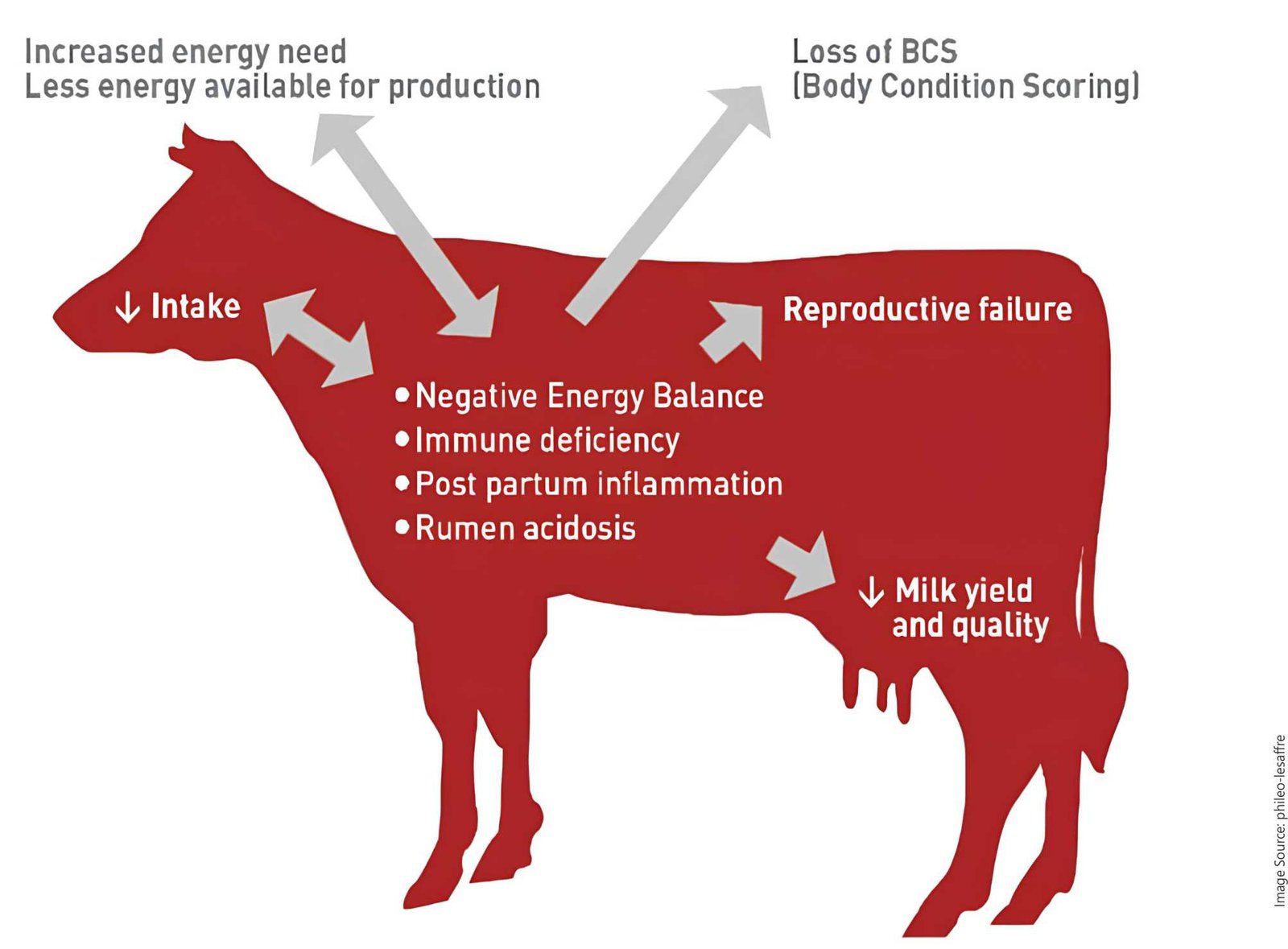
High-genetic-potential cows have high nutrient requirements. If their diets do not provide sufficient energy, protein, minerals and effective fibre, they may fail to express their production potential and can experience excessive loss of body condition.
The challenge is therefore to formulate a ration that provides sufficient nutrients without compromising rumen health.
This is particularly important during early lactation, when nutrient demand rises sharply while feed intake may not increase at the same rate.
A Balanced Approach to Concentrates
Concentrates and cattle pellet feeds can help meet the additional nutrient requirements of producing cows. However, the quantity required should be determined according to the animal’s production level, forage quality, body weight, stage of lactation and the nutrient density of the complete ration.
A commonly used field thumb rule is to offer concentrate according to milk production—for example, around 500 g of concentrate per litre of milk under certain feeding systems—but this should not be treated as a universal formula.
The actual requirement can vary considerably depending on the quality and quantity of forage, milk composition, animal size, production level and the formulation of the concentrate.
Building a More Productive Dairy Herd
Cows with high genetic potential require a balanced supply of nutrients to express that potential for milk production and reproduction. Fibre plays a central role because it influences feed intake, rumination, saliva production and rumen health.
The objective of a successful feeding programme is therefore not simply to increase or decrease fibre. It is to provide adequate, digestible and physically effective fibre as part of a balanced ration.
High-quality green fodder, dry fodder and silage form the foundation of this approach. Their quality depends substantially on decisions made by the farmer—from crop selection and agronomic management to timely harvesting, conservation and storage.
Summary
A productive dairy cow needs more than protein and energy. Fibre is fundamental to maintaining a healthy rumen and supporting consistent feed intake and milk production.
The right balance of fibre, together with good-quality forage, appropriate particle size, adequate concentrates, clean water and sound overall ration management, can help cows maintain rumen health and express their production potential.
For Indian dairy farmers, improving forage quality and understanding effective fibre can be an important step towards more productive, profitable and sustainable dairy farming.
By Dr. T. M. Gowrisankar, Independent Animal Nutritionist and Feed Consultant