

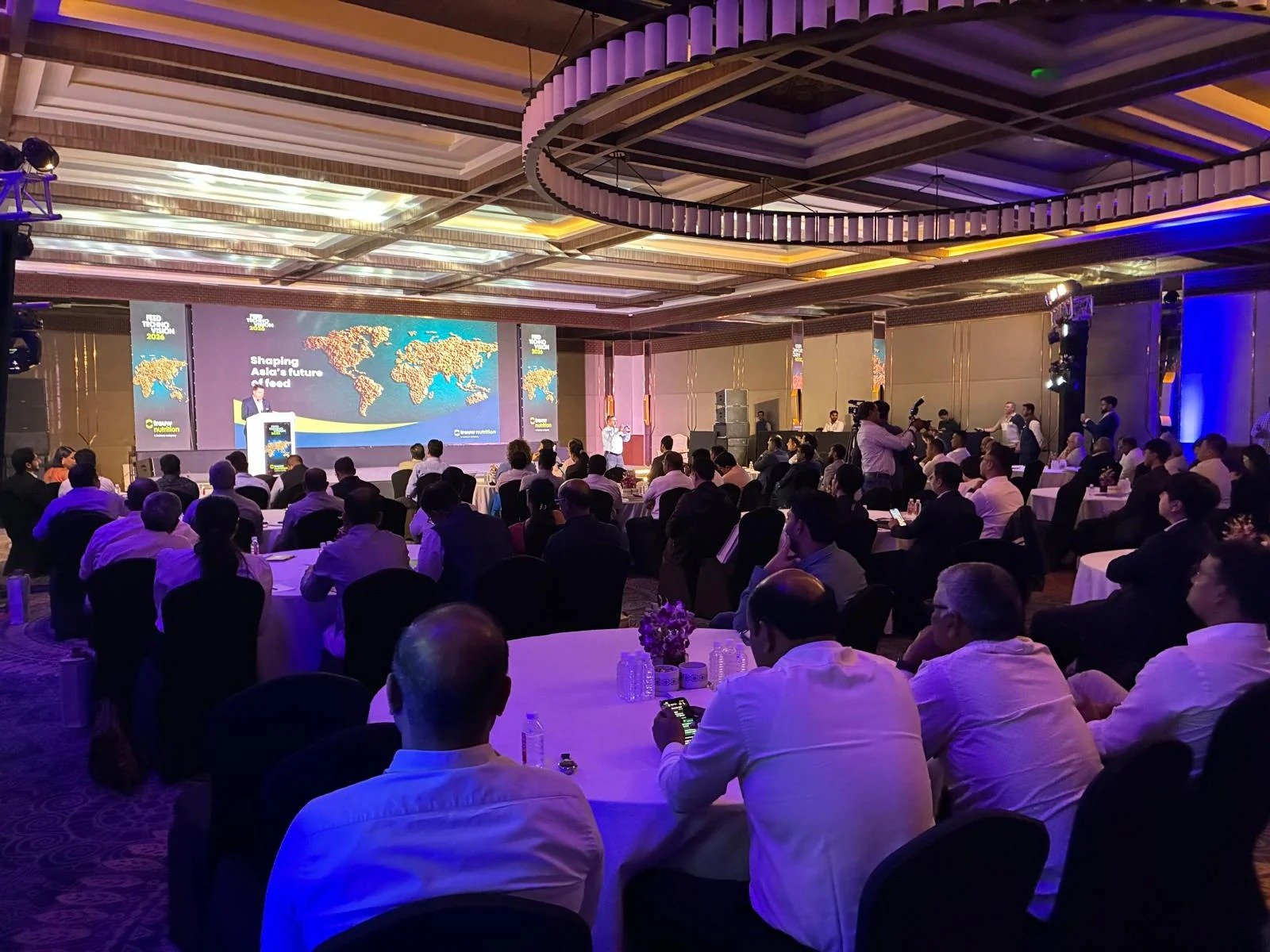
At Trouw Nutrition’s two-day FeedTechnoVision Asia forum, experts from four continents highlighted the enormous growth opportunity for the animal protein industry—and the challenge standing in its way: variability in raw materials, climate and production performance. Their message to the feed community was clear: better measurement, precision formulation, proactive quality management and process control are essential to translating growth potential into consistent results.
International agri-food strategist Osler Desouzart opened FeedTechno Vision 2026 with The Next Ten Years, drawing on his experience in South America and Brazil’s emergence as the world’s largest poultry exporter to highlight Asia’s immense animal protein potential. Describing the region as “two planets”—Planet China and Planet India—he noted that animal product consumption in Asia has grown by 253% since 1965, with rising incomes and low per-capita consumption offering significant headroom for growth.
Drawing lessons from Brazil’s poultry industry, which exports to 176 countries and accounts for approximately a quarter of global poultry trade, Desouzart highlighted the importance of addressing raw-material variability, strengthening process consistency and embracing digitalisation. With feed accounting for 65–75% of live-bird production costs, he underlined that genetics provides the potential, but nutrition and health determine performance.
 Looking ahead, he projected that broilers could reach market weight in just 30 days by 2035, potentially enabling one additional flock annually from existing housing infrastructure. Labour shortages will accelerate automation, while urban consumers increasingly demand convenient, portion-controlled and ready-to-cook products. Realising this potential, however, will require the industry to manage variability more effectively across the feed-to-food chain.
That challenge begins with understanding the raw materials entering the feed mill. Justyna Maczynska, based in Thailand highlighted the urgency of moving from reactive inspection to preventive quality management, particularly amid severe flooding in Bangkok and the threat of El Niño-related crop disruptions. “More variability, less time to react,” she observed.
Emphasising that “animals don’t grow on ingredient names,” she explained that raw materials carrying the same name can differ significantly in nutritional value and risk profile. Consistent feed quality therefore requires more than incoming inspection: manufacturers must assess suppliers, monitor storage and transport conditions, and strengthen controls throughout production. The objective is to anticipate changes, act before they affect performance and make quality a shared responsibility across the organisation.
The impact of ingredient variability becomes particularly clear in nutritional formulation. Dr Roland Koedijk, Global Technical Manager Poultry at Trouw Nutrition, demonstrated how relatively small errors in nutrient assumptions can translate into measurable economic losses. A 1% lower protein level in soybean meal than assumed could cost around 3 cents USD per bird in lost performance, compared with approximately 1 cent per bird to correct the formulation. Errors in digestibility values could cost around 5 cents per bird.
He also cited trials in which diets with identical nutrient specifications but different protein digestion rates resulted in a 120–140 g difference in body weight per broiler. He urged nutritionists to use regional nutrient tables, accurate ingredient values and age-specific digestibility data to formulate for target performance. The underlying principle is to formulate for the nutrients the animal can utilise, rather than relying solely on standard ingredient specifications.
 Weather-related variability also raises concerns about mycotoxin contamination. Dr Swamy Haladi highlighted the potential for heightened mycotoxin challenges in India during 2026–27, as uneven rainfall and late-season rain can influence crop contamination. Fumonisins are emerging as a particular concern, while India continues to experience higher and more variable aflatoxin levels than the Asian average.
Citing illustrative broiler performance impacts of around 200 g lower body weight and a 12-point deterioration in feed conversion, he stressed the importance of multi-toxin testing using LC-MS/MS, rather than testing for individual toxins in isolation. Feed manufacturers need to strengthen surveillance, interpret results in the context of ingredient origin and animal species, and intervene before contamination translates into production losses. The emphasis is shifting from detecting a problem after it occurs to anticipating risks and responding early.
Beyond ingredient quality and formulation, processing conditions play a decisive role in determining the consistency and safety of finished feed. Dr Dejan Miladinovic, Head of the Centre for Feed Technology at the Norwegian University of Life Sciences (NMBU), emphasised that moisture and steam management must be optimised as part of an integrated processing system, rather than through isolated machine adjustments.
Different ingredients absorb moisture at different rates, making a uniform conditioning recipe less effective across formulations. While conventional pelleting gelatinises approximately 10–20% of starch, extrusion at 35–40% moisture enables more extensive cooking, particularly important for aquatic feeds that may need to remain stable in water for up to two hours. Insufficient moisture can increase friction, energy consumption and equipment wear, whereas excess moisture can compromise pellet quality and increase the risk of mould growth and microbial contamination.
His recommendations included using saturated steam, verifying mixer uniformity at least twice a year and maintaining conditioning at 81°C for a minimum of 30 seconds. He also emphasised the need to monitor fines, as excessive breakage can mean losing valuable ingredients and undermining mill profitability. Effective processing, he emphasised, depends on balancing moisture, temperature, equipment performance and final pellet quality.
The connection between processing and feed safety was further emphasized by microbiologist Dr Jean-Michel Nebout of Laboratoire d’Analyses Microbiologiques, France. Nebout, highlighted Salmonella Infantis as an emerging concern due to its multidrug resistance and ability to withstand certain sanitizers. Dutch data cited in his presentation showed prevalence rising from 2–3% at grandparent level to 60–70% at slaughter, illustrating how contamination can accumulate along the production chain.
He identified cleaning and sanitation, feed delivery trucks, feed form and dead-bird handling as four key farm-level factors, accounting for 90–95% of positive flocks in a cited study. At feed mills, contaminated raw materials are a major entry route, while condensation in coolers can encourage bacterial multiplication.
Nebout recommended monitoring temperature, humidity and dew point, insulating coolers to eliminate cold spots, and ensuring hygienic equipment design. He stressed that finished-feed testing alone cannot guarantee safety; continuous process monitoring and contamination prevention are essential. Prevention requires identifying contamination routes and continuously monitoring process conditions before risks spread through the feed-to-food chain.
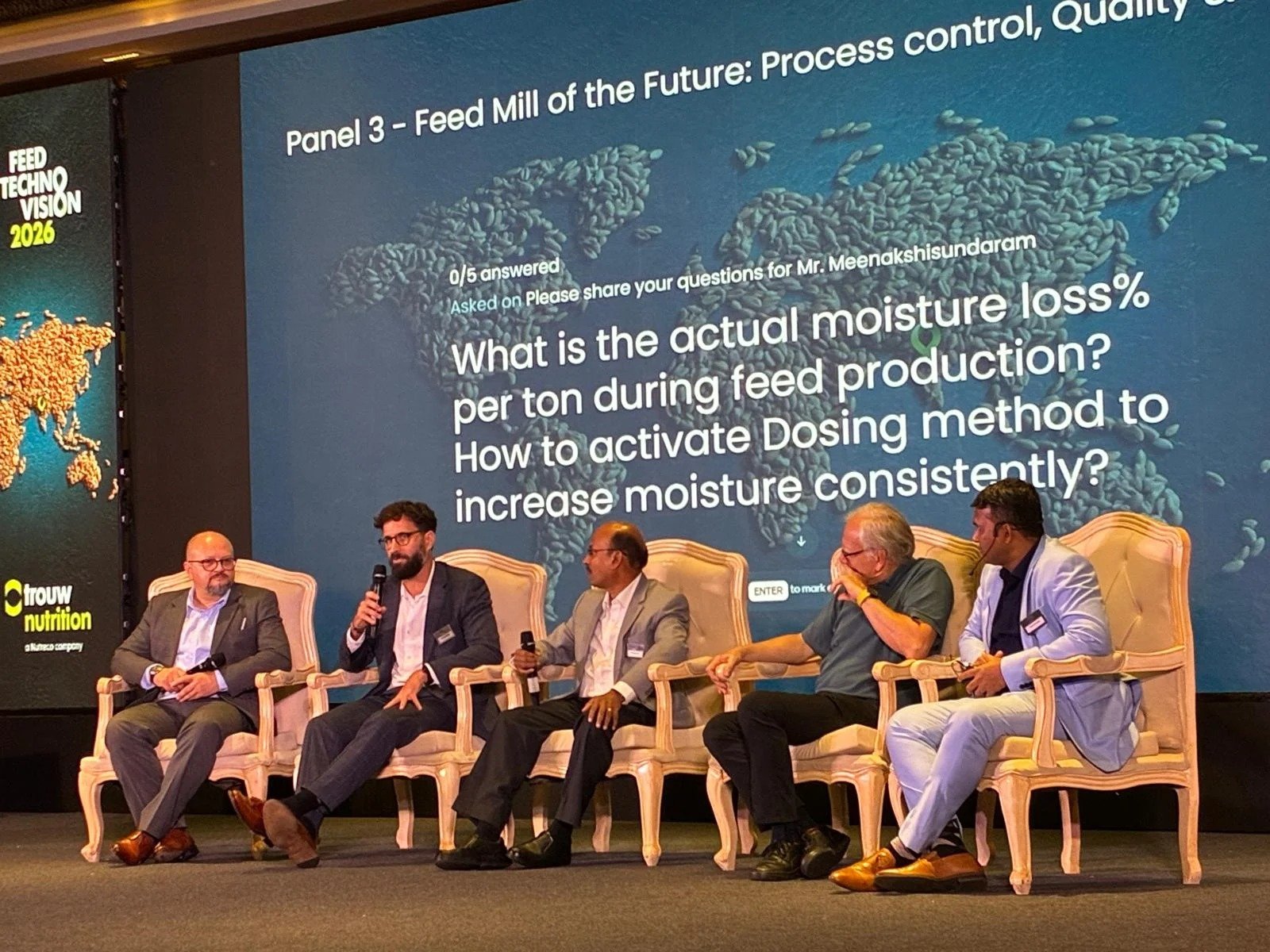
Moisture measurement is another important part of this preventive approach. Moisture loss from mixing to finished feed can reach around 1.5%, depending on incoming moisture, storage duration, grinding temperature and cooling conditions. With ambient humidity across South Asia varying significantly between seasons, feed mills need moisture-management strategies suited to local conditions. In-line sensors can help larger facilities regulate water addition, while smaller mills require cost-effective alternatives.
Dr Eugenio Alcalde cautioned that near-infrared spectroscopy (NIR) readings can differ from laboratory results by ±2%. Regular calibration against reference laboratory analysis, supported by oven methods or dedicated moisture analysers, is therefore essential. The broader lesson is that digital measurements are valuable only when their accuracy is established and maintained.
Digitalisation and Collaboration: From Insight to Impact
Digital tools and artificial intelligence are creating new opportunities to improve decision-making across the feed-to-food chain. Applications discussed included nutritional models that account for ingredient variability, models estimating genetic potential under different production conditions, supply-and-demand analysis and regional mycotoxin monitoring. These tools can help manufacturers assess changing risks and adjust formulations before variability affects animal performance.
However, technology alone cannot deliver consistent results. Reliable data, skilled professionals and clear action plans are needed to turn digital insights into improvements in formulation accuracy, process control and production efficiency.
Lessons from across Asia reinforced the importance of adapting technology and business strategies to local market conditions. Thailand’s shift towards cooked poultry exports, Korea’s global positioning of Korean fried chicken and China’s technology-driven livestock sector demonstrate different ways of building competitive advantages. For India, its market scale, technical talent and digital capabilities offer opportunities to accelerate progress.
Collaboration across the value chain—including feed manufacturers, ingredient suppliers, academia, regulators and even competitors—was another recurring theme. Sharing knowledge, benchmarking performance and addressing common challenges can help the industry improve efficiency while strengthening biosecurity and feed safety.
Closing the discussions, speakers reinforced that the industry’s next phase will depend on translating scientific knowledge and digital capabilities into consistent operational results. Eduardo Alberto, CEO of Trouw Nutrition, captured the central theme: “Growth creates opportunity, science creates possibilities, consistency creates leadership.”
Pedro Caramona, Strategy Director – Feed to Food Safety at Trouw Nutrition, similarly emphasised the opportunity to reduce variability and improve predictability in feed production across Asia. By combining human expertise, precise data, stronger processes and collaborative teams, the feed community can translate nutritional potential into more predictable animal performance.
The organisers announced plans to return to Latin America in 2027 for the fifth edition of FeedTechnoVision.