


Page 13 - Think Grain Think Feed - July 25
P. 13
www.benisonmedia.com  ARTICLE  Think Grain Think Feed - Volume 11 | Issue 9 | July 2025  Think Grain Think Feed - Volume 11 | Issue 9 | July 2025  of probiotics, prebiotics, and   www.benisonmedia.com


                                  inflammation that
                                                            postbiotics—ideally
                                  compromises gut barrier
                                  integrity (“leaky gut”) in
                                                            delivered through next-
                                  poultry. Subclinical infections
                                                            GEH (Gastrointestinal
                                  with Clostridium further
                                                            Environment
                                  exacerbate epithelial     generation technologies like
                                  damage, causing villus    Harmonization)—are
                                  atrophy and apoptosis while   emerging as promising
                                  increasing tight junction   solutions for ensuring
                                  permeability—undermining   optimal gut functionality and
                                  mucosal defenses and      performance under modern
                                  predisposing flocks to    production pressures.
                                  secondary bacterial       Understanding Biotics in
 GUT
 GUT                              to standard anticoccidials   Nutrition
                                  infections. Rising resistance
                                                            Livestock and Poultry
                                  worsens Eimeria-induced
                                                            The concept of integrating
                                  mucosal injury, impairing
                                  nutrient absorption and   “biotics”—namely prebiotics,
                                                            probiotics, postbiotics, and
                                  causing wet litter issues.   synbiotic—has emerged as a
 HEALTH
 HEALTH                           and management            poultry nutrition. As the
                                  Moreover, environmental
                                                            cornerstone in modern
                                  stressors—heat,
                                                            industry moves away from
                                  overcrowding, transport,
                                  feed changes—interfere with   antibiotic dependence due
                                                            to rising antimicrobial
                                  mucin secretion and gut-  resistance, the modulation of
                                  brain axis signaling,     gut microbiota offers a
                                  promoting barrier disruption   sustainable and effective
 Harmonizing Poultry Gut Health:   environmental stress—can   and dysbiosis. Finally, rapid   alternative for promoting
                                  batch turnover limits time for
                                                            intestinal integrity and
        impair gut function
                                  microbial stabilization,
 A Functional Biotic-Based   throughout the bird's life.  leading to inconsistent gut   overall productivity.
                                                            Each biotic category offers a
        Feed components such as
                                  health and heightened cycle-
 Strategy from Concept to Application  mycotoxins, oxidized fats,   to-cycle vulnerability.  distinct yet complementary
                                                            function:
        and anti-nutritional factors
                                  These evolving challenges
                                                            ·   Prebiotics, such as MOS
        (e.g., soy agglutinins) induce
 Dr.  Kalyani  Sarode, Optima Life Sciences  highlight the urgent need for   and XOS, are fermentable
        oxidative stress, alter   advanced, holistic strategies
 As the poultry industry continues its   more susceptible to imbalances in gut   microbiota, disrupt tight   focused on intestinal   oligosaccharides that fuel
 shift toward sustainable, antibiotic-  microbiota, leading to an increased   junctions and mucin layers,   resilience. Approaches   beneficial microbes.
                                                            ·   Probiotics, like Bacillus
 free production systems, managing   prevalence of opportunistic pathogens   and initiate low-grade   involving a synergistic blend
 gut health is becoming increasingly   and chronic enteric conditions.   subtilis, Bacillus clausii,
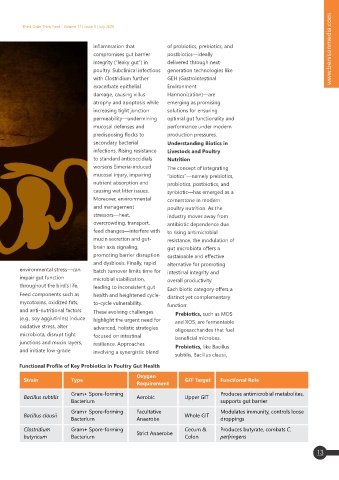
 complex. Emerging challenges are   Additionally, early-life gut   Functional Profile of Key Probiotics in Poultry Gut Health
 reshaping how nutritionists,   development is receiving growing   Oxygen
 veterinarians, and producers approach   attention. The first 7–10 days post-  Strain   Type   Requirement   GIT Target   Functional Role
 intestinal health.  hatch represent a critical window for
                          Gram+ Spore-forming                                 Produces antimicrobial metabolites,
 One of the most critical issues is   microbial colonization, immune   Bacillus subtilis   Aerobic   Upper GIT
                          Bacterium                                           supports gut barrier
 microbial dysbiosis and leaky gut   priming, and intestinal
                          Gram+ Spore-forming    Facultative                  Modulates immunity, controls loose
 diarrhea in the post-antibiotic era.   morphogenesis. Any disruption during   Bacillus clausii   Whole GIT
 With reduced reliance on antimicrobial   this stage—whether due to poor   Bacterium   Anaerobe   droppings
 growth promoters, poultry flocks are   brooding, inadequate nutrition, or   Clostridium   Gram+ Spore-forming   Strict Anaerobe   Cecum &   Produces butyrate, combats C.
         butyricum        Bacterium                               Colon       perfringens

 12                                                                                                             13

